


SEO for artists: a simple guide to getting your art found on Google

SEO for artists means making your website or shop easy for search engines to understand, so that people who search for art like yours find your pages. In practice it comes down to five things:
- Find the words buyers actually type.
- Use those words in your page titles, artwork titles and descriptions.
- Describe every image in text.
- Tell Google your site exists, through Search Console and a sitemap.
- Earn links from other websites and keep adding useful pages.
None of this needs code. It needs clear writing and patience: search traffic builds over months, not days. But once a page ranks, it keeps bringing visitors without a new post every day.
Why SEO is worth it for artists
Social media gets your work seen today and forgotten tomorrow. A page that ranks in Google is found again and again by people who are already looking for what you make.
Search visitors also arrive with intent. Someone searching for "large abstract canvas print blue" is closer to buying than someone scrolling past your post. And unlike a marketplace, the visitors land on your own pages, where you keep the margin and the customer.
Step 1: Find the words buyers use
Artists tend to describe their work the way artists talk: "an exploration of memory in layered glazes". Buyers search the way buyers talk: "blue abstract painting for living room".
Three free ways to find buyer words:
- Google's suggestions. Start typing a phrase such as "botanical print" and note what Google offers to complete it.
- "People also ask" and related searches. These appear in the results and at the bottom of the page.
- Marketplace search bars. Etsy and Pinterest suggest popular searches the same way Google does.
Write the phrases down in a list. Group them by artwork or collection. Each important page should have one main phrase, plus a few close variations.
Look for phrases that combine:
| Part | Examples |
|---|---|
| Subject | Seascape, botanical, horse, city skyline, portrait |
| Style | Abstract, minimalist, watercolor, line art, vintage |
| Product | Art print, canvas print, framed print, original painting |
| Room or use | Living room, bedroom, nursery, office, gift |
| Color | Blue, sage green, black and white, neutral |
Step 2: Write titles and descriptions for search
Artwork and product titles
An artwork called "Untitled 7" or "Whispers" says nothing to a search engine. Keep your poetic title, but add what the work is:
- "Whispers, abstract sage green watercolor art print"
- "Harbor at Dawn, coastal oil painting canvas print"
Put the most important words early. Write for a person first: if the title reads like a list of keywords, it is too much.
Page titles and meta descriptions
The page title is the blue headline in Google's results. The meta description is the short text under it. If your platform lets you edit them:
- Page title: around 50 to 60 characters, with the main phrase near the start and your name at the end.
- Meta description: around 150 to 160 characters, saying what the page offers and why someone should click.
Descriptions
Each artwork page needs a description in your own words. A useful pattern:
- What it shows, in plain words.
- The style and the medium of the original.
- The product: paper or canvas, sizes, framed or unframed.
- The story or inspiration, in two or three sentences.
- Where it fits: a room, a mood, a gift.
Never copy the same description onto every page. Search engines treat repeated text as one page and ignore the rest.
Step 3: Describe your images
Search engines cannot see your art. They read text about it.
- File names. Rename "IMG_4312.jpg" to "sage-green-abstract-watercolor-print.jpg" before uploading.
- Alt text. Describe the image in one sentence, as if to someone who cannot see it: "Abstract watercolor in sage green and cream with loose brushstrokes". Alt text also makes your site accessible to people using screen readers.
- Room pictures. A picture of the print on a wall helps buyers and gives image search another result to show. See how to make art mockups.
Step 4: Get your site into Google
Google finds most sites on its own eventually, but you can speed it up and see what is happening:
- Set up Google Search Console. It is free. You verify that you own the site, usually by pasting a short code into your site's settings.
- Submit your sitemap. A sitemap is a file that lists your pages. Most shop and website builders create one for you. Add its address in Search Console.
- Check the reports after a few weeks. Search Console shows which searches your pages appeared for, how often, and how often people clicked. Those queries are the best keyword research you will ever get, because they are real.
Do the same in Bing Webmaster Tools if you want Bing and the services that use its results.
Step 5: Make the site easy to use
Search engines favor pages that work well for people:
- Mobile first. Most visitors arrive on a phone. Check your pages on yours.
- Speed. Huge image files slow pages down. Upload web-sized images, not your print master files.
- Clear structure. Group work into collections with descriptive names, such as "Coastal watercolors" or "Botanical line art", and link between related pages.
- Secure. The address should start with https.
Most hosted shop builders handle speed, mobile layout and https for you.
Sell your art with Printumo
Get started with selling your art as canvas and fine art prints
Step 6: Earn links from other sites
A link from another website to yours tells search engines that someone vouches for you. A few relevant links beat many random ones.
Places artists earn links:
- Local press and blogs. A short story about your exhibition, market stall or project.
- Galleries, fairs and open studio events that list their artists with a link.
- Interviews and features on art blogs and podcasts.
- Artist directories and art association member pages.
- Collaborations with other artists, cafés or shops that show your work.
Avoid buying links or joining link schemes. They break Google's rules and can hurt your rankings.
Step 7: Add pages that answer questions
Every useful page is one more way to be found. Ideas that work for artists:
- An about page with your name, where you work and what you make. People search for artists by name after seeing their work somewhere. How to write an artist statement helps.
- Collection pages with a short introduction to each series.
- Blog posts about your process, a new collection, a commission, or how to choose a size for a room.
You do not need to post every week. One good post a month, kept up for a year, does more than a burst of ten and then silence.
SEO for art galleries and artist websites
Galleries follow the same steps, with a few extras:
- A page for each represented artist, with a biography and their available work.
- A page for each exhibition, kept online after it closes, so it collects links and searches over time.
- A complete Google Business Profile with opening hours, photos and the exact address, so the gallery shows up in map searches.
- Consistent name, address and phone number everywhere the gallery is listed.
An artist who sells in person should set up a Google Business Profile too if they have a studio that visitors can come to.
Common SEO mistakes artists make
- Only poetic titles. Keep the poetry, add the description.
- Images with no text. A page of pictures and no words gives search engines nothing to rank.
- The same description everywhere.
- Everything on one page. Give each artwork or collection its own page.
- Giving up after a month. Most pages need several months to settle in the results.
Where Printumo fits
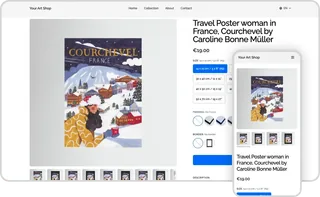
Printumo Shop is a free hosted shop for your art prints, with no monthly fee and 0% commission, and much of the technical SEO is built in:
- Every shop gets its own sitemap, and product pages carry structured data that search engines can use for richer results.
- Product page titles say what is for sale, such as "Harbor at Dawn Canvas Print", unless your own title already says it.
- Product pictures are described for image search with the artwork's name, the product and the frame.
- You can paste verification codes for Google, Bing, Pinterest and Facebook, so you can claim the shop in Search Console and the other tools.
- The shop has a blog. Three posts are free, and Printumo+, the optional paid plan, allows as many as you want and lets you connect a domain you own.
Your part is the part this guide is about: clear titles, good descriptions and pages worth linking to. Printumo prints each order on fine art paper or canvas, unframed or in wooden frames, and ships it to your buyer.
Create a free account to open your shop.
Frequently asked questions
How do artists use SEO?
By describing their work in the words buyers search for: in artwork titles, page titles, descriptions and image alt text. Then they connect the site to Google Search Console, earn links from galleries, press and events, and add useful pages over time.
What are good SEO keywords for artists?
Phrases that combine a subject, a style, a product and a room or color, such as "abstract seascape canvas print" or "minimalist botanical print for bedroom". Find them with Google's suggestions, related searches and your own Search Console data.
How long does SEO take for an art website?
Usually several months before a new page settles in the results. Pages with a clear topic, good text and a few relevant links get there faster.
Can I do SEO for my art shop myself?
Yes. Most of artist SEO is writing: clear titles, honest descriptions and image text. A hosted shop builder handles most of the technical side.