

How to write an artist statement: method, template and four examples

An artist statement is a short text in the first person that says what you make, how you make it and why. The usual length is 100 to 200 words, or one to three short paragraphs. To write one, answer a handful of plain questions about your work, join the answers into a rough draft, then cut every word a stranger would not understand. This guide covers that method, a template you can fill in, and four complete examples.
What an artist statement is for
A statement speaks for the work when you are not in the room: beside a submission, on a gallery wall, or next to a print for sale. You will need it in three lengths:
- One sentence (about 25 words) for social profiles and captions.
- Short (100 to 200 words) for exhibitions, applications and your website. Write this one first.
- Long (up to one page) only when a grant or residency asks for it.
Artist statement vs artist bio vs CV
Applications often ask for all three. The statement is about the work, the bio is about you, and the CV is a list.
| Artist statement | Artist bio | CV | |
|---|---|---|---|
| Subject | The work: what, how, why | The person: background and career | Facts in date order |
| Voice | First person ("I paint") | Third person ("She paints") | No sentences, only entries |
| Length | 100 to 200 words | 80 to 150 words | One to two pages |
| Typical content | Subject, materials, process, intent | Where you live, training, notable shows or clients | Education, exhibitions, awards, publications |
How to write an artist statement step by step
1. Answer five questions in plain words
Write two or three unedited sentences for each.
- What do you make? Name the medium, the scale and the subject.
- How do you make it? Pick the one part of your process that a visitor would be surprised to learn.
- Why this subject or material? Give the real reason, even if it is small.
- What do you want someone to notice?
- What would be missing if another artist had made it?
If you freeze on paper, answer out loud and record yourself. Spoken answers are usually plainer than written ones.
2. Join the answers with a first draft formula
Use this order: what, how, why, effect.
"I make [what] about [subject]. I work with [material or process] because [reason]. [One concrete detail about how a piece comes together.] I want the viewer to [notice or feel what]."
The result will read stiffly. That is fine: the structure is right and only the wording is left to fix.
3. Cut the jargon
Go through the draft and replace every phrase you would not say to a friend over dinner.
| Instead of | Write |
|---|---|
| "My practice interrogates notions of memory" | "I paint places I remember wrongly" |
| "Explores the liminal space between" | Name the two things and say what happens between them |
| "I have always been passionate about art" | Delete it. Every artist can say this. |
Also cut any sentence that could sit unchanged in someone else's statement, such as "my work is about the human condition".
4. Test it on a stranger
Ask someone who has not seen the work to read it and describe what they expect to see. If they are far off, add a concrete detail.
Artist statement template
Fill in the brackets, then reword each sentence.
I make [medium and format] about [subject]. [One sentence on where the subject comes from in your life.]
I work with [materials, tools or process], which [what that choice does to the result]. [One specific detail: a number, a rule you follow, a step most people skip.]
I am interested in [the question or idea behind the work, in plain words]. When you look at a piece, I want you to [notice, feel or ask what].
That comes to around 120 words. If a bracket has no honest answer, drop that sentence.
Sell your art with Printumo
Get started with selling your art as canvas and fine art prints
Artist statement examples
The four statements below are examples written for made-up artists, to show how the formula sounds in different media.
Example 1: an abstract painter
I paint large abstract canvases built from thin layers of acrylic, sometimes forty or more on one painting. I scrape each layer back with a plasterer's trowel before the next goes on, so earlier colors show through in seams and patches. The paintings start from the walls of the harbor town where I grew up: hulls repainted every spring, rust coming through blue, old notices half torn away. I am not trying to picture those walls. I am interested in how a surface keeps a record of everything done to it. Most of my canvases are taller than I am, because I want you to stand close enough to lose the edges and read the surface like a map of small decisions.
Example 2: a landscape photographer
I photograph the coast of northern Denmark in the hour before sunrise, always from a tripod and always with exposures of several minutes. Over that time the waves blur into something closer to fog, and what stays sharp is whatever does not move: a breakwater, a marker pole, a line of stones. I return to the same twelve locations through the year and have done so since 2019. The series measures slow change, a beach that is narrower every winter, against the fast change of weather and light. I print on matte paper with wide margins because these are quiet pictures, and I want nothing shiny between you and them.
Example 3: a digital illustrator
I draw ordinary city life: laundromats, night buses, corner shops at closing time. Everything is drawn on a tablet, but I limit myself to five colors per picture and one textured brush. That keeps the images flat and graphic, like the screen-printed posters I collected as a teenager. I look for the moment in a scene when nobody is performing for anyone: a cashier counting the till, a passenger asleep against the window. People often tell me my pictures feel like a place they have been. That is the aim. I want the unremarkable parts of a day to get the attention usually saved for the dramatic ones.
Example 4: a ceramic artist
I make stoneware vessels by coiling, the oldest and slowest way to build a pot. I do not use a wheel. Each piece grows a few centimeters a day and keeps the marks of my fingers on the inside wall. I mix clay dug from a riverbank near my studio into every batch, so the color shifts from gray to rust depending on where I dug. The forms borrow from storage jars, but most are closed or too narrow to use. I am interested in objects that look useful and refuse to be. Glazes are thin and matte, applied only where a hand would naturally hold the pot.
Common mistakes
- Writing a bio. Where you studied and where you have shown belong in the bio. If a sentence is about you and not the work, move it.
- Telling the viewer what to feel. "This powerful work evokes deep emotion" is a review of yourself.
- Going too long. Past 200 words, wall-text readers stop. Cut the weakest paragraph.
- Never updating it. Reread it whenever you finish a new body of work.
How to adapt your statement
Keep the 100 to 200 word version as the master text and cut the others from it.
How to write an artist statement for a piece of art
Aim for 40 to 80 words. Take one sentence from the master statement, then add what is true only of this piece. For the photographer above:
Marker pole, February. A four-minute exposure made forty minutes before sunrise. The tide was going out, which is why the pole seems to stand in mist and not in water. This is one of twelve places I return to every year, and the beach here is visibly narrower than when I started.
How to write an artist statement for an exhibition
Aim for 100 to 150 words and write about the works in the room, not your whole output. Name the series or show title in the first sentence and say why these pieces belong together. Ask the venue for its word limit and whether it wants first or third person before you start.
A version for your online shop
Aim for 50 to 100 words. Shop visitors scan, so the first sentence must say what you make. Keep one sentence of why, then switch to what a buyer needs: what the prints are made of, and whether originals are available.
Where to use it when you sell your own prints
Your own shop needs these words more than a gallery does, because nobody stands beside the work to talk about it. Put the shop version where a visitor first meets you, and the single-artwork versions beside individual pieces.
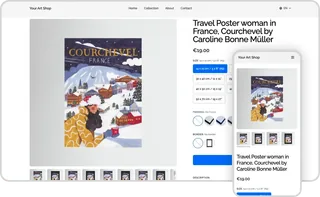
If you do not have a shop yet, Printumo Shop is a free webshop for artists, with no monthly fee and 0% commission. You upload your artwork, and each print is made and shipped when someone orders it. You pay only for the printing and shipping of each print. You can list originals beside the prints, and the shop has a blog (three posts are free) where the long version of your statement can live.
For the rest of the setup, read how to sell art prints online.
Frequently asked questions
How long should an artist statement be?
Between 100 and 200 words for the standard version, which is one to three short paragraphs. Only write a full page when an application asks for it.
What is the difference between an artist bio and an artist statement?
The statement is about the work and is written in the first person. The bio is about you, covers your background and career, and is usually written in the third person. Many applications ask for both, plus a CV.
How do you write an artist statement for a single piece of art?
Keep it to 40 to 80 words. Reuse one sentence from your main statement and add the details that belong only to that piece, such as where and how it was made.