

How to start an art business from home: a step-by-step plan

To start an art business from home, decide what you will sell, make a small, coherent first collection, price it so every sale pays you, and put it in one place where people can buy. Then register the business and keep records as your country requires, and show your work to buyers every week. You can start with very little money if you sell prints made on demand, because nothing is printed until someone has ordered.
The steps below take you from a spare table to your first sales.
Step 1: decide what you will sell
An art business can earn money in several ways. Most artists combine two or three, but it is easier to start with one or two and add more later.
| What you sell | Money needed to start | Time per sale | Good to know |
|---|---|---|---|
| Originals | Materials only | High: each piece is made once | Highest price per sale, but one piece sells once |
| Prints | Low with print on demand | Low once the file is ready | One image can sell many times, in several sizes |
| Commissions | Materials only | High, plus talking to the client | Pets, homes and portraits are common requests |
| Classes and workshops | Low | Fixed hours per class | Online or at your kitchen table, depending on space |
| Licensing | None | Low per deal, slow to find | Companies pay to use your image on their products |
Originals and prints sit well together. Originals give you a story and a higher price. Prints let buyers on a smaller budget own your work, and they keep selling after the original has gone.
Step 2: set up a small workspace
You do not need a studio. You need a corner that stays set up, so you can work in short sessions without unpacking every time.
- A surface you can leave work on, with good daylight or a daylight-balanced lamp.
- Dry, flat storage for finished work and paper, away from damp walls and direct sun.
- A photography spot: a wall with even light where you can shoot every finished piece the same way.
- A packing corner, if you will ship originals yourself: boxes, corner protectors, tape and a scale.
If you will sell prints on demand, the last one shrinks. The prints are made and shipped by the printer, so you never pack them.
Step 3: make a first collection and price it
Aim for 10 to 20 pieces that clearly belong together: the same subject family, a related palette, a similar format. A buyer who likes one should want another. A scattered portfolio is harder to remember and harder to sell.
Then price each product with a simple formula: your costs (materials or print cost, shipping you cover, platform and payment fees) plus the profit you want. Check the result against artists with similar work. Our guide on how to price art prints works through real costs and examples.
For prints, offer a small ladder of sizes, for example a small, a medium and a large. Buyers like a choice, and the larger sizes earn you more per sale.
Step 4: photograph your work and prepare the files
Your photos are your shop. Shoot every piece straight on, in even light, with no glare, and crop to the edges of the artwork. A recent phone is enough for many sizes. Our guide to photographing artwork with an iPhone covers the settings.
For prints, the file needs enough pixels for the size you sell. A common target is 300 DPI for paper prints and 150 DPI for canvas. To find the pixels you need, divide the print size in cm by 2.54 and multiply by the DPI. A 30x40 cm (11.8x15.7 in) paper print at 300 DPI needs about 3,540x4,720 pixels. Save in sRGB, and keep the full-size original file safe.
Step 5: choose where to sell
Start with one or two places and do them well. Each one has a different trade-off.
| Where | Who brings the buyers | What it costs | Best for |
|---|---|---|---|
| Your own shop | You, through social media, email and word of mouth | Varies: from free to a monthly plan | Building a brand you own |
| Etsy | Etsy's search, plus you | Listing fees and a fee per sale | Being found by people already looking for art |
| Art fairs and markets | The event's visitors | A stall fee, plus stock you carry | Meeting buyers and selling originals |
| Instagram and other social apps | You | Free to post, paid if you advertise | Showing process and sending people to your shop |
Our comparison of the best websites to sell art prints looks at the main options side by side. If Etsy suits you, read how to sell art on Etsy.
Step 6: sort out the business basics
Rules differ a lot between countries, and sometimes between regions. Treat this list as questions to answer for your own situation, not as advice. A local accountant or your tax office can tell you what applies.
- Registration. Many countries require you to register as self-employed or as a business once you sell regularly. Find out when that applies to you, and whether the name you trade under must be registered.
- Income tax. Profit from selling art is usually taxable income. Find out how and when you must report it.
- VAT or sales tax. Above certain turnover levels, or when selling to other countries, you may have to charge it. The rules for selling online across borders can differ from those at home.
- Records. Keep every receipt and every sale from day one, in a spreadsheet or simple bookkeeping app. A separate bank account for the business makes this much easier.
- Commissions. Agree the price, size, deadline, deposit and number of revisions in writing before you start.
- Copyright. In general you keep the copyright when you sell a print or an original. Licensing your image to someone else needs a written agreement.
How to start an art business from home with no money
The expensive way to sell prints is to order a batch, store it, and hope it sells. Print on demand turns that around. Each print is made only after a buyer has ordered it, so you have no stock and no print run to pay for up front.
With Printumo, an account is free. You pay the print price and shipping only when a print is ordered, and each order ships to the buyer in neutral packaging with no Printumo branding. There is no minimum order. You can offer canvas and fine art paper prints, framed or unframed, in many sizes. See how it works on the Printumo page for artists.
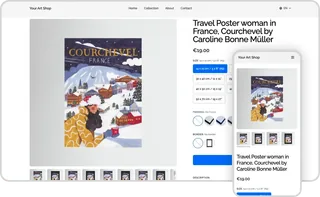
If you do not want to pay for a website, Printumo Shop is a free hosted shop with no monthly fee and 0% commission. Buyers pay by card at the built-in checkout (card fees apply), and you pay only the printing and shipping of each print sold. You can list originals beside your prints and ship those yourself. If you are based outside the EU and sell to private buyers in the EU, Printumo is responsible for the VAT on those sales and keeps it back from the payment. Your own domain, discount codes and detailed statistics need Printumo+, the optional paid plan, but you can start without it.
What still costs something: your materials, your time, and a test print of your own work, which is worth seeing before you sell it. Printumo gives 30% off the prints and frames in your first order when you place it within 48 hours of signing up.
Sell your art with Printumo
Get started with selling your art as canvas and fine art prints
A simple weekly routine
A home business competes with everything else in the house. A fixed routine protects the time. This one fits around a part-time job:
| Block | Time | What you do |
|---|---|---|
| Making | 2–3 sessions | New work for the current collection |
| Photographing and listing | 1 session | Shoot finished work, prepare files, add new products |
| Showing the work | 3 short sessions | Post process and finished pieces, reply to comments and messages |
| Admin | 30 minutes | Record sales and costs, answer orders, check stock of materials |
| Review | 15 minutes | What sold, what got attention, what to make next |
The admin block is the one people skip. Thirty minutes a week is easier than a lost weekend at tax time.
Your first 90 days
Days 1–30: build. Choose what you sell and where. Finish or select 10 to 20 pieces for a first collection. Photograph them and prepare print files. Set your prices. Find out what registration your country requires.
Days 31–60: launch. Open your shop and list the collection. Tell everyone you know: friends, family, past colleagues. Post three times a week. Start an email list, even if it has 20 names. Order a print of your own work to check it in person.
Days 61–90: learn. Look at what sold and what got attention, and make more of it. Apply for one local market or fair. Raise or adjust prices where something sells easily or not at all. Plan the next small collection.
Expect slow early sales. Most buyers need to see your work several times before they buy, so the routine matters more than any single launch.
Common mistakes to avoid
- Pricing too low. A price that only covers materials pays nothing for your time and leaves no room for fees or wholesale later.
- Selling everywhere at once. Five half-filled shops reach fewer people than one that is complete and well photographed.
- Ordering stock before you know what sells. Let buyers tell you, then make more of that.
- Skipping records. Rebuilding a year of sales from bank statements is slow and stressful.
Frequently asked questions
How do I start an art business from home with no money?
Sell prints made on demand, so nothing is printed until a buyer has ordered and paid. A free account and a free hosted shop let you start with only your existing work and your time. Your main costs are materials and, ideally, one test print.
How do I start an art business online?
Choose one place to sell, such as your own shop or Etsy, list a coherent collection with good photos and clear prices, then show the work every week on social media. Printumo Shop, for example, is a free hosted shop with prints made on demand. Add more channels once the first one works.
Do I need to register my art business?
It depends on your country and how much you sell. Many countries require registration as self-employed or as a business once you sell regularly, and profit from sales is usually taxable. Check with your tax office or an accountant.
What sells best for a home art business?
Prints of a coherent collection are the easiest to scale, because one image can sell many times in several sizes. Originals and commissions earn more per piece but take more time. Most artists combine them.
Can I sell prints of my art without a printer at home?
Yes. With print on demand, a print partner makes each print when it is ordered and ships it straight to the buyer. You upload the file once and set your prices.