

How to sell your art locally: 9 places to start in your own town

To sell your art locally, put it where people in your town already spend time, and make it easy to buy on the spot or later. The places that work best for most artists are:
- Cafés, restaurants and bars
- Independent shops and boutiques, often on consignment
- Art fairs, craft fairs and markets
- Open studios and art walks
- Local galleries and artist co-ops
- Libraries, community centers and local events
- Offices, hotels, clinics and other businesses that need art
- Interior designers and home stagers
- The street, where it is allowed
Selling locally has an advantage no website can copy: people meet you and see the real work. They remember the artist, not just the picture, and that is how a buyer becomes a collector.
Why sell locally at all
- Real relationships. Someone who met you at your studio is far more likely to buy again and tell their friends.
- Fast feedback. You see in an afternoon which pieces stop people, and which prices make them hesitate.
- Less competition. Online you compete with every artist in the world. In your town, with a handful.
- It feeds your online sales. Local buyers become followers, newsletter readers and online customers.
The local options compared
| Where | Effort | What sells | How you get paid |
|---|---|---|---|
| Café or restaurant wall | Low once hung | Mid-size framed work, originals | Usually through the venue or a card with your shop link |
| Shop or boutique | Low to medium | Small prints, cards, affordable originals | Consignment or wholesale |
| Fair or market | High on the day | Small and mid-size prints | Card reader and cash |
| Open studio or art walk | Medium | Originals, signed prints | Card reader, bank transfer |
| Gallery or co-op | Medium | Originals, limited editions | Commission on sales |
| Business or office | Medium | Larger work, series | Invoice |
| Street | High, weather-dependent | Small, cheap prints | Card reader and cash |
1. Cafés, restaurants and bars
Many cafés are happy to fill their walls with local art for free. Walk in at a quiet hour with a few photos on your phone or a small portfolio, and ask who decides about the walls.
Agree on the details before you hang anything:
- How long the work stays up.
- Whether the venue sells it and takes a share, or buyers contact you.
- Who is responsible if a piece is damaged or stolen.
- Whether you may leave cards or a small sign.
Put a small label next to each piece with the title, the price and a QR code that links to your online shop. Free QR generators are easy to find. Many people will not buy over their coffee, but they will scan and look later.
2. Independent shops and boutiques
Gift shops, concept stores, bookshops and interior shops often sell local art. There are two usual arrangements:
- Consignment. The shop displays your work and pays you when it sells, keeping a share. You carry the risk of unsold stock but keep ownership until it sells.
- Wholesale. The shop buys your prints outright at a lower price and sells them at its own retail price. You get paid at once.
For consignment, get it in writing: the shop's share, when you are paid, how long work stays, and who covers damage or loss. Keep a list of everything you leave and visit regularly to swap stock.
Bring products that suit a shop: small prints in sleeves, cards and a few framed pieces at gift prices.
3. Art fairs, craft fairs and markets
Markets put you in front of hundreds of people who came to browse and buy. They take the most work on the day: stock, a display, a card reader and a full day of talking.
The details of choosing an event, what to bring and how to set up a booth are in how to sell art at art fairs and markets.
4. Open studios and art walks
Many towns run open studio weekends or monthly art walks. If yours does, join. If it does not, open your own studio for an afternoon, or team up with two or three local artists.
Visitors at an open studio come to see how art is made. Leave work in progress out, show your tools and sketches, and have finished pieces and prints ready to buy. It is one of the best places to sell originals, because the buyer has met the artist and seen the process.
5. Local galleries and artist co-ops
A local gallery or co-op gives your work a professional setting and its own visitors. Galleries usually take a commission on each sale. Co-ops usually ask members for a fee, shifts at the desk, or both.
Visit before you approach: look at what they show and whether your work fits. How to get into an art gallery covers the approach in detail.
6. Libraries, community centers and local events
Libraries, town halls, community centers and festivals often hold exhibitions of local work. Sales are not always allowed on site, but these shows get you seen, and sometimes mentioned in the local paper. Always bring cards.
7. Offices, hotels and other businesses
Businesses need art on their walls: offices, hotels, dentists, clinics, co-working spaces, estate agents. This can mean larger orders than a single buyer, and sometimes a series of matching pieces.
Make a short one-page offer with a few examples, sizes and a price range, and approach businesses whose look fits your style. Some prefer to rent art and change it every few months, which can give you a regular income.
8. Interior designers and home stagers
Interior designers look for art that fits a room and a budget, and stagers dress homes for sale. Both need work quickly, in specific sizes and colors. Send a short portfolio grouped by color and mood, and make it clear that you can offer prints in several sizes.
9. Selling art on the street
Street selling is the most direct option and the most regulated one. Many cities require a permit or a license to sell on public ground, and some restrict where and when. Rules differ from city to city, so check with your local council before you set up.
If it is allowed, keep it simple: small prints at prices people decide on in seconds, a stand that packs away quickly, a card reader, and protection from rain.
Sell your art with Printumo
Get started with selling your art as canvas and fine art prints
Pricing when you sell locally
Keep your prices the same locally and online. If a print costs less at the market than in your shop, online buyers feel cheated, and if it costs more, local buyers will just order online. Rewarding local supporters is still fine. Do it with something extra rather than a different price, such as a signed card, an early look at a new series, or an invitation to your next open studio.
When a venue takes a share, your price must still leave you a profit after that share. How to price art prints has a formula to check this.
Getting local people to know you
- Local Facebook groups and neighborhood apps. Share where your work can be seen, not only what is for sale.
- Location tags and local hashtags on Instagram.
- The local paper and radio. A new exhibition, a mural or a charity piece is a story. Send a short note with one good photo.
- A Google Business Profile if you have a studio visitors can come to, so you appear on maps.
- An email list. Bring a sign-up sheet to every event, and write when you have something new or a place to see you.
- Collaborations. A joint show with a photographer, a pop-up with a ceramicist, a print for a local brewery's tap room.
Turning local buyers into regulars
Every local sale is a chance for the next one. Include a thank-you card with your shop link and your social handle. Remember names. Invite past buyers to openings. Tell them the story behind the piece they bought, because they will repeat it to every guest who asks about it.
And make sure they can buy from you when you are not there. A buyer who loved a piece at the café may want it in a bigger size, or as a gift for someone in another city.
Where Printumo fits
Printumo prints fine art paper prints and canvas prints, unframed or in wooden frames, and supports local selling in two ways.
Stock for walls, shops and markets. You can order prints for yourself, shipped to your own address, for a café wall, a consignment shop or a market table. An account is free, you pay the print price plus shipping, and the pricing page shows the cost of each size. There is 30% off your first order when you place it within 48 hours of signing up, which is a good moment to order samples.
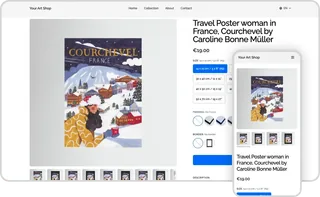
A shop for everything you cannot bring. Printumo Shop is a free hosted shop with no monthly fee and 0% commission. Point your QR codes and cards to it. Local buyers can order the size they want, and each print is made and shipped straight to them, or to whoever they are giving it to. You can also list your originals in the shop beside your prints, at your own price, and deliver those yourself.
Create a free account to set it up.
Frequently asked questions
How can I sell my art locally?
Start where people already spend time: cafés, independent shops, markets, open studio events and local galleries. Agree terms in writing with any venue, label your work with prices and a QR code to your shop, and collect email addresses so you can keep selling after people leave.
Where can I sell my paintings locally?
Originals sell best where buyers can meet you or see the work up close: open studios, art walks, local galleries and co-ops, and cafés or restaurants with good wall space. Offices, hotels and interior designers buy too, often in larger quantities.
Do I need a permit to sell art on the street?
In many cities, yes. Rules on selling in public places differ by city and country, so check with your local council before you set up a stand.
Should I sell my art on consignment?
Consignment is a low-cost way into local shops, because you pay nothing up front. Agree the shop's share, the payment schedule and who covers damage in writing, and keep a list of the work you leave.