

How to sell art on Instagram: prints and originals, step by step

To sell art on Instagram, treat the app as your shop window and keep the till somewhere else. Switch to a professional account, put a link to a shop in your bio, and post work in a way that makes people want to own it: the process, the finished piece on a wall, and the story behind it. Instagram brings the buyers. The sale happens behind the link, where the buyer sees the price, picks a size and pays safely.
You do not need thousands of followers for that. You need a way to buy that is obvious to anyone who likes a post.
Set up a professional account
Instagram offers two kinds of professional account: business and creator. Instagram describes creator accounts as best for public figures, content producers, artists and influencers, and business accounts as best for retailers, brands and service providers. Both give you insights on your posts and followers, and you can switch between them later.
You switch in the app's settings under "Account type and tools". One thing to know first: if your account is private, switching makes it public, and pending follow requests are accepted automatically. Menu names change between app versions, so follow Instagram's own help page for the current steps.
If you will sell through a link in your bio, either type works. Instagram's own shop features (see below) need a business account.
Write a bio that sells
You have a short bio and room for up to five links. Use them like this:
- Line one: what you make. "Abstract landscapes in acrylic" says more than "artist and dreamer".
- Line two: what can be bought. "Prints and originals, shipped to your door" or "Commissions open for spring".
- First link: your shop. Put it at the top, so every "link in bio" means one place.
- Other links, optional: a newsletter sign-up or a commission form.
Every extra link is one more choice before a buyer reaches the shop, so use as few as you can.
Where the sale actually happens
There are two routes, and most independent artists use the first.
A shop behind your bio link. The buyer taps the link, lands on your shop, picks a size and pays by card. You need no product catalogue and no approval from Meta.
Instagram's own shop features. Meta lets businesses set up a shop and tag products in posts, but it runs on a product catalogue in Meta's Commerce Manager. According to Meta's help pages, you need a business account, a catalogue, a supported country and a review that can take up to four weeks, and the shop needs a checkout link to your own website. Meta's help pages also say some Shops and checkout features are no longer supported. If you go this way, check the current requirements for your country first.
What to post: content that turns followers into buyers
People rarely buy from a single post. They buy after they have seen the work, the person behind it and the work in a home. Mix these types:
| Post type | What it does | Example |
|---|---|---|
| Process Reel | Shows the skill and time behind a piece | 30 seconds of a painting from blank canvas to final stroke |
| Finished piece, close up | Shows texture, colour and detail | A slow pan across the surface in daylight |
| The piece on a wall | Answers "how would it look at home?" | A mockup in a living room, or a photo in your own home |
| The story | Gives a reason to care | Where the place is, why you painted it, what the title means |
| The offer | Says plainly what can be bought | "Available as a print in three sizes. Link in bio." |
Mockups matter more than most artists expect. A flat photo shows the art. A mockup shows a buyer their own wall. Our guide on how to make art mockups covers the options, and you can try the Printumo mockup generator with one artwork without an account.
Good photos come first, though. If you shoot your work with a phone, read our guide to photographing artwork with an iPhone.
Post consistently, at a pace you can keep
Three posts a week for a year will do more than daily posts for a month followed by silence. A simple weekly rhythm:
- One process Reel. Film while you work, so it costs little extra time.
- One finished piece, with its story in the caption.
- One selling post, showing the piece on a wall and saying how to buy it.
- Stories on most days: work in progress, a question for your followers, a reminder of what is in the shop.
Reply to comments and messages. Conversations are where followers become buyers.
Hashtags, realistically
Hashtags put a post on hashtag pages, but they will not build an audience on their own. Since late 2025 Instagram has been limiting posts and Reels to five hashtags, so pick ones that describe the work.
Choose specific tags over huge ones: your medium and subject ("watercolour birds"), your style, and your city or region. A tag used on millions of posts buries yours within minutes.
Show the price or write "DM for price"?
"DM for price" has a cost. Every buyer has to send a message and wait, and many will not bother. Some assume the work is out of reach.
Showing the price works better for prints and most originals. It filters out people who were never going to buy and lets the right buyer act straight away. A good compromise is "prints from €35" in the caption, with the full price list in your shop.
"Price on request" can make sense for large originals and commissions, where the price depends on size, framing or delivery. If you use it, answer within a day. For the numbers themselves, read how to price art prints.
Taking orders in DMs, safely
Many sales start in a direct message. Finish them somewhere safer.
- Send a link, not your bank details. Point the buyer to the item in your shop so they pay at a proper checkout.
- Confirm the details in writing: size, framed or unframed, and the delivery country.
- Ship only when the money is in your account, not when someone sends a screenshot saying it is.
Scams that target artists
Artists sell to strangers and want to be helpful, which makes them a favourite target. The patterns repeat:
- The overpayment. A keen "collector" who asks little about the work sends a cheque or transfer for more than the price, then asks you to send back the difference or pay "their shipper". The payment later bounces or is reversed, and the money you sent is gone.
- The fake payment notice. An email says the money is waiting, but you must pay a fee or click a link to release it.
- The paid "feature". An account offers promotion, an exhibition or a competition entry for a fee. Look up the organiser before you pay anything.
- The account warning. A message says your account will be deleted and asks you to log in through a link. Do not use the link. Open the app yourself and check there.
One rule covers most of them: never send money to someone who wants to buy from you.
Selling prints vs originals on Instagram
Originals are one of a kind, so each sale is an event. Announce them in advance, show the real piece in natural light, and be clear about size, medium and postage. You pack and ship originals yourself.
Prints let one image sell many times at a lower price, which makes them easier to buy on impulse, and they keep selling after the original has gone. With print on demand, each print is made when it is ordered, so you hold no stock.
Many artists offer both. The originals are why people follow you. The prints are what most of them can afford. If you sell limited editions, keep your own count. Our guide to open vs limited edition prints explains the difference.
Drops and collaborations
Drops. Release a small group of new pieces at a set time, and announce it a week ahead in posts and Stories. A clear time gives followers a reason to come back.
Collaborations. Instagram's Collabs feature lets you invite another account to co-author a post. If they accept, the post appears on both profiles and reaches both sets of followers. You can add up to five collaborators. Good partners are artists with a similar audience, a framer or interiors shop, or a café that hangs your work.
Sell your art with Printumo
Get started with selling your art as canvas and fine art prints
Use a Printumo Shop as your link in bio
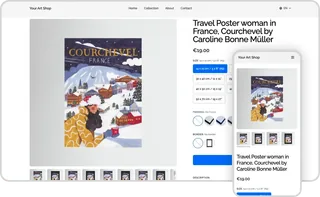
Your bio link needs to go somewhere that sells. Printumo Shop is a free hosted shop for artists, at an address like printumo.com/shop/your-name, so you do not need your own website.
- Prints on demand. Upload your artwork and set your prices. Each canvas or fine art paper print, framed or unframed, is made when someone orders it and shipped to the buyer.
- No monthly fee and 0% commission. You pay only the printing and shipping of each print you sell. Buyers pay by card at the built-in checkout (card fees apply), and payouts go through Stripe to your own account.
- Originals beside prints. List an original with your own price and postage, as a one-off or a small edition. You ship it yourself, with 0% commission.
- Mockups made for you. Every product gets mockups in its real frame, mat and size, and a shared product link shows a mockup as its preview picture.
- Ready for ads. If you later advertise on Instagram, you can connect a Meta Pixel, and optionally the Conversions API, to see which ads led to orders.
Your own domain, discount codes and detailed statistics need Printumo+, the optional paid plan. You do not need it to open the shop and start selling.
One limit to know: Printumo Shop does not create a product catalogue for Meta, so its products cannot be tagged in Instagram posts. Your bio link, Stories and captions do that job.
Frequently asked questions
How do I sell art on Instagram without a website?
Use a hosted shop as the link in your bio. A Printumo Shop, for example, has its own address on printumo.com, takes card payments and needs no website of your own.
How do I sell art on Instagram as a beginner?
Switch to a professional account, write a one-line bio that says what you make, and add a shop link. Post a mix of process videos, finished work and work shown on a wall, about three times a week. A large following is not needed for your first sales, but a clear way to buy is.
How do I sell art prints on Instagram?
Put your prints in a shop that offers several sizes and link it in your bio. Show them in room mockups so followers can picture them at home, and mention the starting price in captions.
How do I sell original art on Instagram?
Announce a piece before it goes on sale, show it in natural light, and state size, medium and price clearly. Send buyers to a shop listing so they pay at a checkout, and ship only once the payment has arrived.
Can you sell directly on Instagram?
Meta offers shops and product tags to eligible business accounts, but they need a product catalogue in Commerce Manager, a supported country and a review. The rules have changed several times, so check Meta's current help pages. Most independent artists sell through a shop linked in their bio instead.