


How to price art prints: a formula, real costs and worked examples

To price art prints, add up what one sale costs you and put your profit on top:
Retail price = (print cost + shipping you absorb + platform and payment fees) + your profit.
Then check the result against what artists with similar work and a similar audience charge. If your number is far below theirs, you are leaving money behind. If it is far above, you need a reason a buyer can see, such as a larger size, a frame or a signed edition.
The cost lines in the formula
Print cost. What the printer charges for one print in one size. With print on demand you pay it only when a buyer orders, so it is a cost per sale and never stock on a shelf.
Shipping you absorb. If you offer free shipping, the full shipping charge is your cost. If you charge the buyer for shipping, this line is zero or only the part you cover.
Platform and payment fees. Whatever the place you sell takes from each order. More on this below.
Your profit. What is left for your time, your marketing and the artwork itself. This is the only line you choose freely.
A worked example
Take a 50x70 cm (20x28 in) unframed canvas sold with free shipping. The print cost is Printumo's for Germany. The shipping figure is the starting canvas rate, and the fee level is an assumption for the example. Replace both with the rates for your buyer's country and your platform.
| Line | Amount |
|---|---|
| Retail price | €119.00 |
| Print cost | €39.32 |
| Shipping you absorb | €8.00 |
| Fees, assumed at 10% of the sale | €11.90 |
| Profit | €59.78 |
How much to charge for art prints: a price table
The costs below are real Printumo seller costs for prints delivered in Germany, in EUR, excluding VAT and shipping, fetched on 11 November 2026. They vary by country and can change. The retail prices are examples to show the method. They are not recommendations.
| Product | Print cost | Example retail price | Profit per sale before fees |
|---|---|---|---|
| Fine art paper 30x40 cm (12x16 in), unframed | €8.80 | €35 | €26.20 |
| Fine art paper 50x70 cm (20x28 in), unframed | €12.00 | €55 | €43.00 |
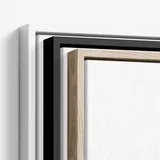
| Fine art paper 50x70 cm (20x28 in), framed | €48.00 | €129 | €81.00 |
| Canvas 30x40 cm (12x16 in), unframed | €17.76 | €69 | €51.24 |
| Canvas 50x70 cm (20x28 in), unframed | €39.32 | €119 | €79.68 |
| Canvas 100x150 cm (40x60 in), unframed | €101.18 | €289 | €187.82 |
Shipping, fees and any VAT you owe still come out of the last column.
Look at the pattern. The small paper print sells for about four times its cost and earns €26. The large canvas sells for under three times its cost and earns €188. The multiple shrinks as the product gets more expensive, while the profit in euros grows. That is normal, and it is why a fixed "cost times three" rule works badly across a whole range.
How much to charge for canvas prints
Canvas costs more to make than paper because it is stretched over a wooden frame, and buyers expect to pay more for it because it arrives ready to hang. In the table, a 50x70 cm canvas costs about three times as much as the same size on paper, and the example retail price is a little over twice as high.
Price canvas from its own costs. Do not derive it from your paper prices. Shipping is the line to watch: large canvases travel in big boxes, so check the shipping rate for your largest sizes before you promise free delivery.
Platform fees: what to check
Fees differ a lot between places to sell, and they change. Look for these four kinds on the platform's own fee page and use the current figures:
- Listing fees. A charge for publishing or renewing each listing, paid whether it sells or not.
- Transaction fees or commission. A percentage of each sale, sometimes charged on the shipping amount too.
- Payment processing fees. What the card or payment provider charges, usually a percentage plus a small fixed amount per order.
- Monthly subscription. A fixed cost for running a shop. Divide it by your expected monthly orders to see what it adds to each sale.
Percentage fees are charged on the selling price, so they grow when you raise prices. A fixed fee per order hurts small prints most.
Sell your art with Printumo
Get started with selling your art as canvas and fine art prints
VAT and sales tax
In the EU and the UK, prices shown to consumers include VAT where it applies, so part of the price a buyer pays may not be yours to keep. Whether you have to charge it, and at what rate, depends on your country, your turnover and where the buyer lives. In the US, sales tax varies by state. This is not tax advice: ask an accountant before you set final prices.
Pricing by size so the ladder makes sense
A simple ladder for unframed paper could be €35 for 30x40 cm (12x16 in), €55 for 50x70 cm (20x28 in) and €85 for 70x100 cm (28x40 in). With print costs of €8.80, €12.00 and €22.40, the profit before fees climbs from €26.20 to €43.00 to €62.60.
Two rules keep a ladder healthy:
- Profit rises with every size. The print cost of paper climbs slowly, so most of each price step is profit. Bigger sizes should always pay you more in absolute terms.
- Steps are even. A jump from €35 to €55 to €140 makes the largest size look like a mistake. Keep the gaps in proportion.
Psychological price points
Prices ending in 9 or 5 (€49, €95) read as lower than the next round number, which helps on small prints bought on impulse. Round numbers (€120, €300) read as confident and suit large pieces and limited editions.
Your most expensive item also changes how the others look. A €289 canvas at the top of the page makes a €119 version feel moderate, even if few people buy the top one.
Framed vs unframed pricing
A frame raises your cost and your profit at the same time. In the table, framing a 50x70 cm paper print adds €36.00 of cost (from €12.00 to €48.00). The example retail price goes up by €74, so the framed version earns €81.00 against €43.00.
Buyers accept that gap because the alternative is buying a frame and fitting the print themselves. Price the framed version so that it earns more than the unframed one, and check its shipping cost separately, because framed prints ship in larger parcels.
Open vs limited editions
An open edition can be printed without limit and is priced on the formula above. A limited edition has a fixed number of signed, numbered prints and sells for more because it is scarce, which only works if you keep an honest count and stop when it sells out.
When and how to raise prices
Raise prices when sales are steady at the current level, when your costs go up, or when your audience has grown.
Do it in small steps of around 5 to 10 percent. Start with new releases, then bring older work in line. If you have a mailing list, tell subscribers a week ahead: it is fair, and it often brings a few orders at the old price.
Re-check your print and shipping costs a couple of times a year. A price that worked last year can lose its profit without you changing anything.
Discounts without training buyers to wait
If you run a sale every month, buyers learn to wait for the next one. Keep discounts rare, short and tied to a reason: a new collection, a yearly sale, a thank-you to subscribers.
Run the formula on the discounted price first. A €55 print at 20 percent off sells for €44, and your costs stay the same, so the whole €11 comes out of your profit. A bundle (a lower price on the second print) often protects profit better than a blanket discount.
How to price art prints for wholesale
Shops and galleries usually expect to buy at around half of your retail price, because they need their own profit when they resell. This is a convention, and terms vary, but it means your retail price must leave room for it.
Test it on the €55 paper print. Wholesale would be about €27.50. With a €12.00 print cost you still earn before shipping. A print priced at €25 retail would leave almost nothing at wholesale. If you ever want shops to carry your work, price for it from the start, and keep your own retail price at or above theirs.
Start with the exact cost of every size
The first number in the formula is the print cost. Printumo's price tables show the exact cost of every canvas and fine art paper size, framed and unframed, for each country you sell to.
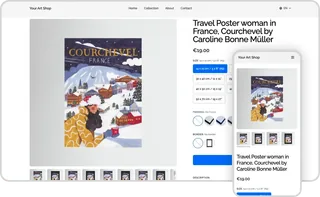
An account is free and you pay only when a print is ordered. You can create an account and connect your own store, or open a free Printumo Shop and set your prices there.
For the steps after pricing, read how to sell art prints online.
Frequently asked questions
How much should I charge for art prints?
Add your print cost, the shipping you cover and your fees, then add the profit you want. In the examples above, unframed paper prints run from €35 to €85 and canvases from €69 to €289, but your own figure depends on your costs, your country and what comparable artists charge.
Is selling art prints profitable?
It can be. With print on demand you hold no stock, so each sale is profitable as long as your price covers print, shipping and fees. How much you earn in total depends on how many buyers you reach, so marketing matters as much as the price.
How do I price art prints for wholesale?
Assume a shop will pay around half of your retail price and check that this still covers print cost and shipping with profit left over. If it does not, your retail price is too low for wholesale.