


How to hang art without nails

You can hang art without nails in eight common ways: adhesive strips, adhesive hooks, a picture ledge, leaning the piece on furniture or the floor, a picture rail with hooks and cords, brick clips, a tension rod or easel, and washi tape or poster putty for light unframed prints. Which one works depends on three things: how heavy the piece is, what the wall is made of, and how bad it would be if the piece fell.
The options compared
Light means an unframed print or a small canvas, medium means a mid-size canvas or a small framed print, heavy means a large frame with glazing. Every adhesive product has a weight rating on the packaging. Check it against the actual weight of your piece.
| Method | Suits | Weight class | Walls it works on | What can go wrong |
|---|---|---|---|---|
| Adhesive strips | Framed prints and canvases with a flat back | Light to medium. Check the rating on the pack | Smooth painted drywall or plaster, glazed tile, sealed wood | Lets go on textured, dusty or damp walls. Can lift paint if pulled off the wrong way |
| Adhesive hooks | Pieces with a wire, ring or sawtooth hanger | Light to medium. Check the rating on the pack | Same as strips | Same as strips, and the piece can tilt on a single hook |
| Picture ledge or shelf | Several pieces you want to swap and layer | Medium to heavy, if the ledge is properly fixed | Any wall | A ledge needs screws, so it means a few holes instead of one per picture |
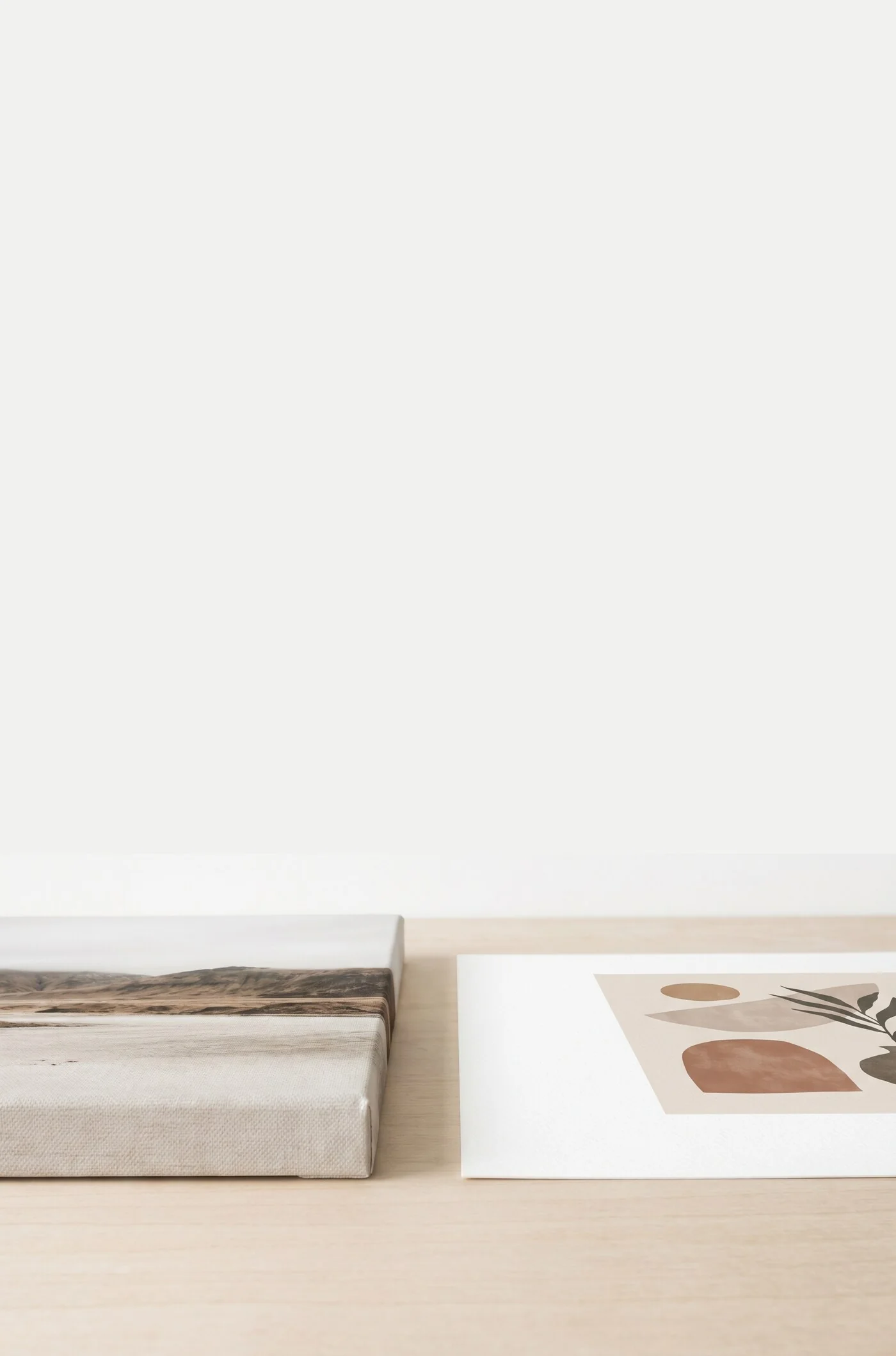
| Leaning on furniture or the floor | Large framed pieces and big canvases | Any | No wall contact needed | Can be knocked over by children, pets or a vacuum cleaner |
| Picture rail with hooks and cords | Anything, in homes that already have a rail | Medium to heavy, depending on the rail and hooks | Any, usually older plaster walls | Only free of holes if the rail is already there |
| Brick clips | Framed prints and canvases on exposed brick | Light to medium. Check the rating on the pack | Brick with recessed mortar | Will not grip if the mortar is flush or the brick is the wrong height for the clip |
| Tension rod or freestanding easel | One piece in an alcove, or a feature piece on the floor | Light on a rod. Medium to heavy on a sturdy easel | No wall contact (a rod presses between two walls) | Rods slip under too much weight. Easels take floor space |
| Washi tape or poster putty | Unframed paper prints and postcards | Light only | Smooth painted walls | Putty can leave a greasy mark. Tape can lift weak paint and may mark the print |
How to hang art without damaging walls using adhesive strips
Adhesive strips are the usual answer when you want to hang art without damaging walls, and most failures come from skipped steps. Follow them in order.
- Weigh the piece. Stand on a bathroom scale with and without it, or use a kitchen scale for small frames. Choose strips rated above that weight, and use the number of pairs the pack tells you to.
- Check the wall. Strips are made for smooth, painted surfaces. They do not hold reliably on wallpaper, textured paint, bare brick or dusty surfaces. Fresh paint needs time to cure first, and the strip maker states how long.
- Clean the spot with isopropyl alcohol (rubbing alcohol) on a cloth and let it dry.
- Press the strips firmly onto the back of the frame, then press the frame to the wall. Hold for the time the instructions give.
- Wait before the strips carry the full load. Many makers ask you to lift the frame off, press the wall strips again, and leave them for a set time (often about an hour) before hanging. Follow the time on your pack.
- Hang the piece and check that it sits flat. If the back of the frame has hardware that keeps it away from the wall, the strips cannot make full contact.
Temperature and humidity matter. The packaging lists a working temperature range, and most strips are not made for steamy rooms, the wall above a radiator, or a spot in direct sun. Use a product rated for bathrooms if that is where the piece is going.
To remove a strip, do not pull it toward you. Hold the frame or hook, take hold of the tab, and pull it slowly straight down, parallel to the wall, until the strip stretches and releases. Pulling outward is what tears the paint.
Sell your art with Printumo
Get started with selling your art as canvas and fine art prints
How to hang art by wall type
Drywall
Smooth painted drywall is the easiest surface for strips and hooks. Rub the wall with a finger first: if color comes off, the paint is too weak to trust with a strip.
How to hang art on plaster walls
Plaster is hard but brittle, and it can crack or crumble around a nail. Old plaster is also often uneven, and strips need full, flat contact. Use them only on a smooth, well-painted area and for light pieces.
Many older plaster homes have a picture rail: a wooden molding running around the room below the ceiling. Hooks rest over the rail, and cords or wires drop down to the frame. If you have one, use it: it carries real weight and leaves the plaster alone.
How to hang art on a brick wall
To hang art on a brick wall without drilling, use brick clips: sprung metal brackets that grip the top and bottom edges of a single brick and put a hook on the front.
Clips only work if the mortar is recessed, so the brick stands proud enough for the clip to bite. Measure the height of one brick before you buy, because clips are made for specific brick heights. Adhesive strips do not hold on bare brick, which is too rough and dusty.
Concrete
Smooth, painted concrete takes adhesive strips the same way drywall does. Bare concrete is porous and sheds dust, so adhesives fail on it. Without drilling, lean the piece or use an easel.
Tile in bathrooms
Glazed tile is smooth and non-porous, so adhesives bond well to it. Stick strips or hooks to the tile itself, never across a grout line, and choose a product rated for humid rooms.
How to hang art by artwork type
How to hang a canvas without nails
A stretched canvas is light for its size, because it is fabric over a wooden frame with no glazing. That makes it the easiest wall art to hang without nails.
Put adhesive strips on the wooden stretcher bars at the back, top corners first, then the bottom corners to keep it from swinging. If a hanger or bumpers on the back hold the bars away from the wall, use an adhesive hook made to take that hanger instead, or stand the canvas on a ledge.
Framed prints
A frame with glazing weighs much more than the print inside it. Glass is the heaviest option and acrylic glazing (plexiglass) is lighter. Weigh the finished frame instead of guessing. For a large framed piece, leaning it on a sideboard or the floor is often the best no-nail choice.
Unframed paper prints
Washi tape or poster putty will hold a light paper print on a smooth wall. Both touch the print, so use them for prints you can replace. For anything you care about, clip the print to a hanger bar or a clipboard and hang that from an adhesive hook, so nothing sticks to the paper.
Where to hang it
Hang a single piece so its center sits about 145 to 150 cm (57 to 60 in) from the floor, which is roughly eye level for a standing adult. Above a sofa, bed or sideboard, leave 15 to 25 cm (6 to 10 in) between the top of the furniture and the bottom edge of the art.
With strips you get one attempt at the position, so mark the top corners lightly in pencil before you peel anything.
When a nail or screw is the better choice
Some pieces should not hang on adhesive. A heavy frame, a valuable original, and anything above a bed or a sofa where people sit deserve a proper fixing into the wall.
A single small nail hole is often easier to repair than the damage from a failed strip. Filler and a touch of paint hide a nail hole. A strip that tears off a patch of paint, or drops a glazed frame, costs more to put right.
If you rent, read your lease. Many leases allow a few small nail holes, but yours may not, so check your own agreement or ask the landlord in writing.
Canvas prints and no-nail hanging
A Printumo canvas print arrives ready to hang, with a sawtooth hanger already fitted and rubber bumpers on the back.
A sawtooth hanger is made to sit on a nail or a screw. For a no-nail hang, weigh the canvas and use adhesive strips or hooks rated for that weight, or stand it on a picture ledge.
Printumo's framed paper prints have a plexiglass front, which keeps them lighter than a glass-fronted frame. The frame options are on the framing page.
Frequently asked questions
How do you hang art in an apartment without making holes?
Use adhesive strips or hooks for light and medium pieces on smooth painted walls, and lean larger pieces on furniture or the floor. Read your lease as well, because many allow small nail holes.
How do you hang art on plaster walls without nails?
Use the picture rail if the room has one, with rail hooks and cords. Otherwise use adhesive strips for light pieces on a smooth, well-painted patch of wall.
How do you hang art on a brick wall without drilling?
Use brick clips, which grip the top and bottom edges of one brick. They need recessed mortar and a brick height that matches the clip. Adhesive strips do not hold on bare brick.
Can you hang a canvas without nails?
Yes. A canvas has no glazing, so it weighs little for its size. Put adhesive strips rated for its weight on the stretcher bars, use an adhesive hook that takes its hanger, or stand it on a ledge.