



How to get into an art gallery: an honest guide

Here is how to get into an art gallery, stated plainly: a gallery takes on artists whose work fits its program and who already show a consistent body of work. Mass emails to fifty galleries rarely get a reply. The route that works is slower. You research a few galleries that suit your work, become a familiar face there, and then send a professional submission in the way each gallery asks for it.
What galleries look for
A gallery is a business with a point of view. Its collectors trust the owner's taste, and every new artist has to make sense next to the ones already on the walls. Good work that does not fit the program is still a no.
Beyond fit, most gallerists look for three things:
- A coherent body of work. Around 10 to 20 recent pieces that clearly belong together in subject, technique or mood.
- A recognizable direction. Someone should be able to see one of your pieces and guess it is yours.
- Evidence of commitment. Regular output, past group shows, a tidy website, sales you have made yourself. A gallery invests time and wall space, and wants to know you will still be producing in two years.
Types of venues and what to watch for
"Gallery" covers very different arrangements. Knowing which one you are dealing with tells you how to get featured there and what it will cost you.
| Venue | How it works | What to watch for |
|---|---|---|
| Commercial gallery | Selects artists, sells their work and earns a commission on each sale. You do not pay to exhibit. | Fit with the program, the commission rate, any exclusivity by city or region. |
| Artist-run or co-op space | Members share the rent and the running of the space, often for a membership fee and shifts at the desk. | The yearly cost in money and hours, and how often you get to show. |
| Vanity or pay-to-show gallery | You pay a fee for wall space or a place in a show, sometimes with a commission on top. | The gallery earns from artists whether or not anything sells, so these offers deserve scrutiny. |
| Open calls and juried shows | You submit work, often for an entry fee, and a jury selects pieces for a group exhibition. | Who the jurors are, the fee, and who pays shipping both ways. |
| Cafes and local businesses | They hang your work informally, and you handle the sales. | Who is responsible for damage or theft, and how buyers pay. |
| Art fairs | You, or a gallery representing you, rent a booth for a few days and sell directly to visitors. | Booth, travel and display costs against what you can realistically sell. |
Questions to ask about a pay-to-exhibit offer
Paying to show is not automatically a bad deal. Co-ops and juried shows charge fees and can be well worth it. But when an invitation arrives out of the blue, praising your work and quoting a price, ask before you pay:
- What does the fee cover, and what other costs follow (shipping, framing, catalog)?
- Does the gallery also take a commission on sales?
- How many works sold at recent shows, and can you speak with artists who exhibited there?
- How does the gallery promote the show to buyers?
- Is there a written agreement, and what happens to unsold work?
A venue that answers openly is giving you something to weigh. One that avoids the questions has told you enough.
How to research galleries that fit
Aim for a list of about ten galleries. For each one, look at the artists it represents and its exhibitions from the past two years. Ask yourself honestly whether your work would look at home in that group, at a similar price level and career stage.
Useful places to look:
- The CVs of artists whose work is close to yours and who are a step or two ahead. Where they showed early on is your shortlist.
- Local galleries you can visit in person.
- Each gallery's website, for a submissions page. Some review portfolios at set times of year, and some say clearly that they do not accept submissions.
How to approach galleries as an artist: build the relationship first
Most new artists reach a gallery through an introduction, or because the gallerist already knows who they are. You can build that without being pushy.
Go to openings, look properly at the work, and talk with the staff about the exhibition. Follow the gallery and its artists online and sign up for the newsletter.
Do not bring your portfolio to an opening or pitch across the desk on a busy Saturday. The aim at this stage is that your name and face are familiar and your interest in the program is obviously real. When your submission arrives later, it comes from someone they recognize.
Get to know the artists the gallery already shows, too. A recommendation from one of them carries more weight than any email you can write.
Sell your art with Printumo
Get started with selling your art as canvas and fine art prints
The submission package
Check each gallery's submission policy first and follow it exactly: the format, the number of images, the time of year. If the policy says no unsolicited submissions, respect it and keep building the relationship instead.
Where submissions are welcome, a standard package looks like this:
- A short email. Five or six sentences, addressed to a named person.
- 8 to 12 images of recent work from one series, each labeled with title, medium, size, year and price. For example: "Low tide, oil on linen, 60 x 80 cm (24 x 32 in), 2026, $1,400".
- An artist statement. One or two short paragraphs on what the work is about.
- A short bio and a CV listing education, exhibitions and awards.
- A link to your website, where the same work is shown cleanly.
Here is an example email. The names are invented, and yours should sound like you:
Dear Ms. Ortega,
I have followed the gallery since your "Northern light" group show last spring, and the quiet landscape work you show is the reason I am writing.
I am a painter based in Leeds. My current series, "Low tide", is 14 oil paintings of estuaries at dusk. Three were selected for this year's regional open exhibition.
I have attached 10 images with details and prices, a short statement and my CV. The full series is on my website: example.com.
Thank you for taking the time to look.
Kind regards, Anna Marsh
If you hear nothing, one polite follow-up after a few weeks is fine. After that, let it rest.
How to sell art to a gallery: consignment in practice
Galleries rarely buy work outright. The usual arrangement is consignment: you lend the gallery the work, it sells the piece to a collector, and it keeps a commission. The commission is commonly around half of the sale price, but it varies.
What follows is common practice, not legal advice. Before any work leaves your studio, ask for a written consignment agreement that covers:
- A list of the works, with titles, sizes and retail prices
- The commission rate, and who absorbs any discount given to a collector
- How long the gallery keeps the work, and how either side can end the arrangement
- Who pays for shipping, in both directions
- Who insures the work at the gallery and in transit
- When you get paid after a sale
For a larger commitment, have someone qualified read the agreement.
Keep your prices consistent
A collector who pays $1,400 at the gallery and then finds a similar painting for $900 on your website will not come back, and neither will the gallery. Your own prices for comparable work must match the gallery's retail prices.
So set prices with the commission in mind. If you need $700 for a painting and a gallery takes half, the retail price is $1,400 everywhere, including your studio and your own shop.
What to do while you wait
Gallery relationships take months or years to form. Use that time to build the evidence a gallerist wants to see:
- Enter open calls and juried shows that suit your work. Each selection is a CV line and a chance to meet curators.
- Organize or join group shows with other artists.
- Build your own audience with a newsletter.
- Sell work yourself. A record of sales shows that people want what you make.
Our guide on how to make money selling art online covers the main income routes.
Prints and originals: an income you control
Galleries usually deal in originals. Prints are a separate income stream that you can run yourself while the gallery side develops. If you sign with a gallery, check what your agreement says about selling prints and other work on your own.
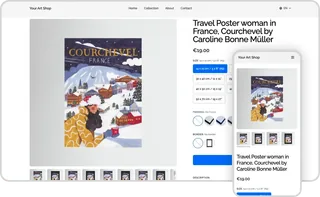
Printumo is a print-on-demand service for wall art: you upload an artwork, and each print is made and shipped to the buyer when it is ordered. Printumo Shop is a free hosted webshop with no monthly fee and 0% commission. You pay only for the printing and shipping of each print sold.
You can also list original artworks beside the prints. You set the price and the postage per region and ship the originals yourself, with an optional "price on request" setting. That gives you one address to put in a submission email.
Frequently asked questions
How do you get your art in a gallery for the first time?
Build a coherent body of 10 to 20 recent works, then shortlist galleries whose artists are close to you in style, price and career stage. Visit them, get known, and submit only in the way each gallery asks. Open calls and group shows are the usual first step onto a gallery wall.
How do you get featured in an art gallery without representation?
Juried shows, open calls, co-op spaces and group exhibitions all show artists who are not represented. Read the terms of each, including fees, commission and shipping, before you enter.
How do you sell art to a gallery?
In most cases you do not sell to the gallery. You consign work, the gallery sells it to a collector, and you receive the sale price minus the commission. Agree the terms in writing before handing over any work.