


How to find your art style: a method that works

The honest answer to how to find your art style is that you do not choose one. A style is what remains after you make a lot of work and notice the decisions you keep repeating: the same kind of subject, the same few colors, the same way of handling an edge. You find it by producing work and then reviewing it, in that order.
That sounds slow, but it can be organized. The method below uses a reference collection, a few practice copies and one series of 10 to 20 small pieces.
What an art style is made of
Every finished picture is the result of a handful of choices. A style is a set of those choices that stays stable from one piece to the next.
| Element | The question it answers | Examples of choices |
|---|---|---|
| Subject | What do you keep painting or drawing? | Faces, houseplants, empty streets, birds, pure shapes |
| Palette | Which colors, and how many? | Three earth tones, muted pastels, black plus one bright accent |
| Value range | How light or dark is the whole picture? | High contrast, pale and airy, dark and moody |
| Line | Is there visible line, and what kind? | Thin even outline, broken sketchy line, no line at all |
| Edges | How do shapes meet? | Crisp cut-out edges, soft blends, lost edges in shadow |
| Texture | What does the surface look like? | Flat color, visible brushstrokes, paper grain, collage |
| Composition | How is the picture arranged? | Centered subject, lots of empty space, tight crop, strict symmetry |
| Level of detail | How much do you describe? | A few simplified shapes, medium detail, every leaf rendered |
| Medium and format | What is it made with, and at what size? | Gouache on paper, digital brushes, square format, tall panels |
You do not need a fixed answer in every row. Two or three rows held constant are usually enough for a group of pictures to look like they came from the same hand.
How to find your art style for beginners: the five steps
If you are a beginner, the steps are the same as for anyone else. Expect your answers to change more often, because your skills are changing too.
Step 1: collect 20 to 30 works you love
Save 20 to 30 pieces by other artists that you would happily hang on your own wall. Choose quickly, and include work outside your medium: photographs, textile patterns and book covers all count. With fewer than 20 you will not see patterns, and with many more than 30 the patterns blur.
Step 2: name what they share
Put the images side by side and go through the table above row by row. Write down what at least a third of them have in common. Be specific: "warm grays with one saturated red" is useful, "nice colors" is not.
You may think you love detailed realism and find that 20 of your 30 picks are flat shapes with strong outlines. The collection shows your taste more accurately than your opinion of it does.
Step 3: copy to study, for practice only
Pick three or four pieces from the collection and copy them as closely as you can. Copying shows you what you only guessed by looking: how thick that line really is, how few colors were used.
Keep these copies private. Do not sell them, and do not post them as your own work. If you do share one, label it clearly as a study and name the original artist.
Step 4: make a series of 10 to 20 small pieces under fixed rules
This is the step that produces a style. Set constraints before you start and keep them for the whole series:
- One size. Small enough to finish in a sitting, for example 15x15 cm (6x6 in) or 13x18 cm (5x7 in).
- One medium. No switching halfway.
- One subject family. For example "things on my kitchen table" or "trees in the local park".
- A fixed palette. Three to five colors plus white.
- A time limit. 45 to 60 minutes per piece keeps you from polishing.
Constraints remove most decisions, so the ones that are left become visible. An example: 15 gouache paintings of houseplants, 15x15 cm, using only ultramarine, burnt sienna, yellow ochre and white.
Step 5: review side by side, keep what repeats, drop the rest
Lay out the whole series and look at all of it at once. Go through the table of elements again and write down what shows up in most pieces without you having planned it. Those unplanned repeats are the start of your style.
Drop what appeared once or twice and felt forced. Write three to five sentences that describe the repeats ("thick dark outline, flat color, subject cropped at the edge, lots of empty background") and use them as the constraints for your next series.
Sell your art with Printumo
Get started with selling your art as canvas and fine art prints
A self-assessment instead of an art style quiz
If you searched for a "how to find your art style quiz", you want a shortcut. A multiple-choice quiz can only sort you into labels someone else made up. The questions below work better, because the answers come from your own work and taste. This is a reflection exercise with no score. Write your answers down.
- Which subject do you draw or paint when nobody has asked you for anything?
- In the 20 to 30 works you collected, which three colors appear most often?
- Do you prefer pictures with strong light and dark contrast, or pictures that stay within a narrow, quiet range?
- When you look at a piece you love, do you notice the line first, the color first or the shapes first?
- Do you enjoy the slow last 20% of a detailed piece, or do you lose interest once the main shapes work?
- Are your favorite pictures busy and full, or mostly empty space?
- Which medium makes you lose track of time?
- Which of your own pieces would you sign without hesitating, and what do those have in common?
- What do other people say they recognize in your work?
- Which part of making a picture do you avoid, and could your style simply leave it out?
How to read your answers
Look for agreement between answers. If questions 2, 3 and 6 all point to quiet, pale, sparse pictures, that is a direction worth a full series.
Look for conflict too. If question 5 says you dislike detail but your collection is full of it, you admire that work without wanting to make it. Follow what you enjoy doing.
Question 10 matters more than it looks. Many recognizable styles are built on omission: no backgrounds, no faces, no shading.
How to develop an art style once you have a direction
Finding a direction and developing an art style are two different jobs. Development is repetition with small changes.
Run another series with the constraints you wrote down in step 5, and change one variable only: a new subject with the same palette, or the same subject at a larger size such as 30x40 cm (12x16 in). If the work still looks like yours, that element was not essential. If it stops looking like yours, you have found a core part of your style. Date your work, so you can compare series made months apart.
How long does it take to find your art style
There is no fixed number of hours or years. It depends on how much you make and review far more than on calendar time.
A focused series of 10 to 20 pieces, made over a few weeks, is usually enough to see your first repeated decisions. A style that strangers recognize takes much longer and many more series. It also keeps shifting, so treat a style as a current position.
Common traps
- Waiting for a style before you start. A style is a result of work, so it cannot come first. Start the series with constraints that are only a guess.
- Copying one artist. If all your studies come from one person, you will produce a weaker version of their work. Study at least three or four artists, so that what you take from each gets mixed.
- Changing medium every week. Each switch resets your skill level, and you never get past the stage where the material is fighting you. Stay with one medium for a whole series.
How a consistent style helps when you sell
A buyer who likes one of your pieces often looks at the rest. If the rest looks related, they see a recognizable body of work, which is easier to remember than a set of unrelated pictures.
Consistency also gives you collections that hang together. Pieces with the same palette and format look right side by side, which matters to anyone planning a wall with two or three prints.
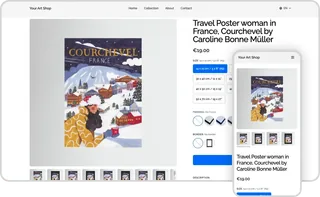
Once you have a series you are happy with, you can sell it as a collection of prints. Printumo Shop is a free hosted webshop for artists where you can group your artworks into collections, and each print is made and shipped when someone orders it. There is no monthly fee and no commission. You pay for the printing and shipping of each order.
For the practical side of files, pricing and where to list your work, read how to sell art prints online.
Frequently asked questions
How do I find my art style as a beginner?
Use the same method as everyone else: collect 20 to 30 works you love, name what they share, copy a few for practice, then make 10 to 20 small pieces under fixed constraints and review them together. As a beginner, expect your answers to change as your skills grow.
Is there a quiz that tells me my art style?
A quiz can suggest labels, but it cannot see your work, so treat any result as a prompt at most. The 10 reflection questions above are more useful, because they make you compare your taste with what you enjoy doing.
How long does it take to find your art style?
There is no fixed figure. A focused series of 10 to 20 pieces is usually enough to notice your first repeated decisions, while a style that other people recognize takes years of regular work and review. It also keeps changing for as long as you keep working.
Is it okay to copy other artists while I am learning?
Copying for practice is a long-established way to learn, as long as the copies stay studies. Do not sell them or present them as your own work, and credit the original artist if you show one.