



How to choose art for your living room: size, colour, style and light

To choose art for your living room, decide in this order: the wall and the size, then the colour, then the mood, and only then the individual piece. Size comes first because it is the mistake people notice most. Colour and mood narrow thousands of options down to a handful. After that, pick what you would still like to look at in five years.
Start with the wall, not the artwork
Pick the wall before you look at a single print. Usually it is the one above the sofa, or the one you face when you walk in. Then measure. The size you need depends on what stands in front of the wall:
| Where the art goes | How to size it |
|---|---|
| Above a sofa | Two thirds to three quarters of the sofa's width |
| Above a sideboard or fireplace | Two thirds to three quarters of the furniture's width |
| A wall with no furniture | About 60 to 75 percent of the open wall width |
| Between two windows or beside a door | A single portrait piece, with a clear margin on each side |
These proportions count a whole group of pieces as one, measured from the outer edges. We worked them out in detail, with tables for every common sofa width, in what size art above a couch. The short version: a 210 cm (83 in) sofa wants art about 140 to 158 cm (55 to 62 in) across, and the bottom edge should sit 15 to 25 cm (6 to 10 in) above the sofa back.
On a wall without furniture, centre the art at about 145 to 150 cm (57 to 60 in) from the floor.
Choose a colour approach
There are three ways to handle colour, and each one works. The trick is to choose one on purpose.
- Pull from the room. Pick art that repeats one or two colours you already have: a cushion, a rug, the wood of a table. The room feels calm and finished. This is the safest choice for a first piece.
- Contrast with the room. In a room of greys and whites, a piece with one strong colour becomes the focal point. Warm art in a cool room (or the opposite) works the same way.
- Stay neutral. Black and white photography, line drawings and soft earth tones fit almost any room and survive a change of sofa or paint.
Judge the overall colour from across the room, not up close. Our guide to colour theory for artists explains why some colours sit quietly together and others clash. It is as useful for choosing art as for making it.
Decide on the mood
Ask what the room is for. A living room where you read and unwind suits quiet work: landscapes, soft abstracts, still lifes, a limited palette. A room where you host and talk can take something bolder: strong graphic shapes, high contrast, bright colour.
Style matters less than you think. A modern abstract can sit in a traditional room, and an old botanical study can sit in a minimal one. What makes it work is a link: a shared colour, a material, or a similar level of calm or energy.
If you are stuck, save 15 to 20 pictures of art you like and look for what repeats: usually the same palette or the same kind of subject. That is your brief.
One statement piece or a gallery wall
Both work in a living room. They suit different rooms and different people.
| One statement piece | Gallery wall | |
|---|---|---|
| Effect | A calm focal point | Personal, collected over time |
| Best for | Rooms that already have pattern and colour | Plain rooms that need interest |
| Planning | Simple: one size, one height | More work: layout, spacing, matching |
| Buying | One larger purchase | Can grow piece by piece |
| Risk | Too small for the wall | Looks cluttered without a common thread |
A gallery wall needs one thing the pieces share: a palette, a subject or a frame colour. Our gallery wall layout ideas give eight layouts with sizes and spacing.
Canvas or framed paper
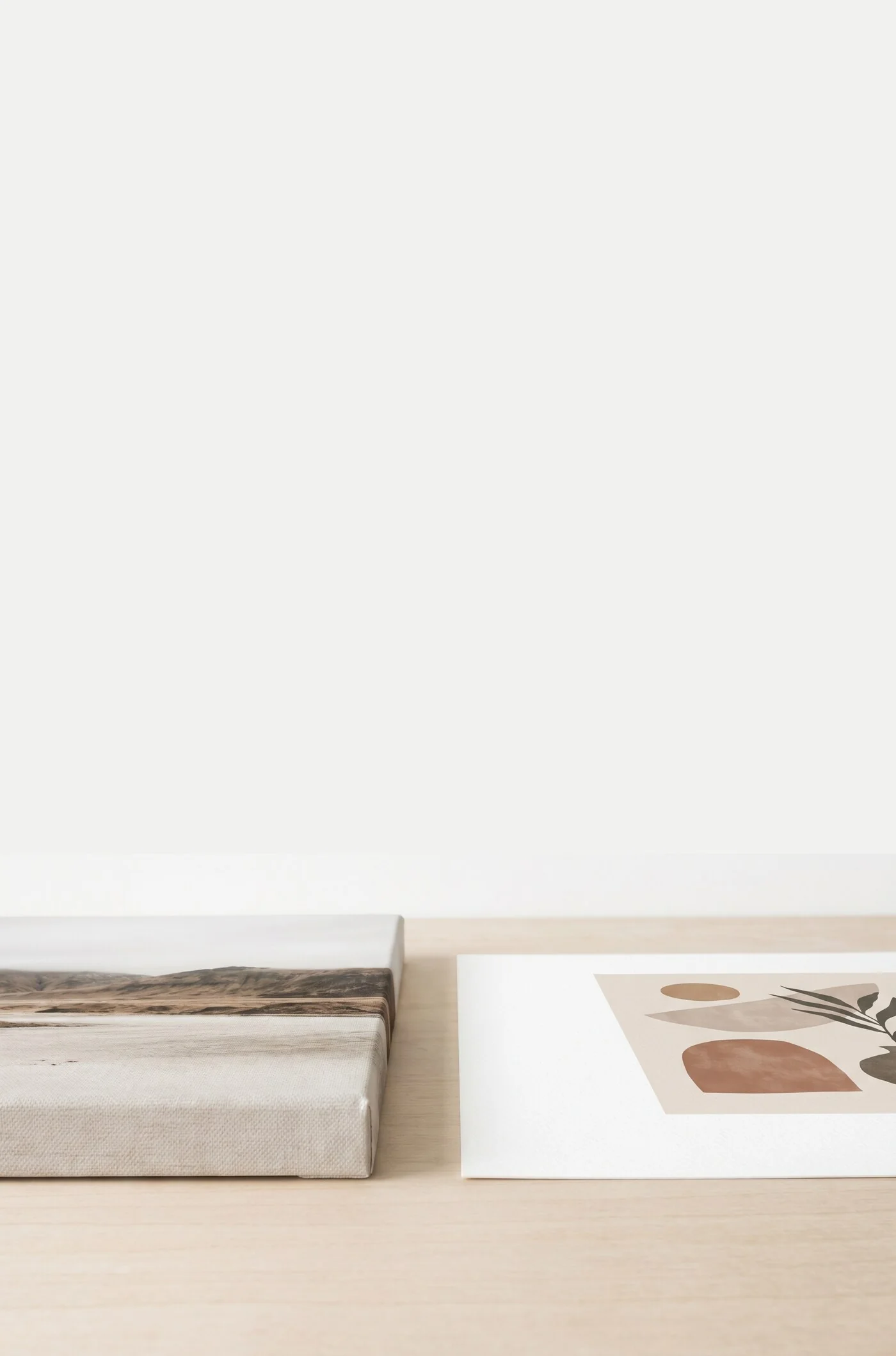
Most art you can buy for a living room comes as a canvas or as a print on paper in a frame. They look and behave differently.
| Canvas | Framed paper print | |
|---|---|---|
| Surface | Printed canvas stretched over a wooden frame | Paper behind a glazed front, often with a mat |
| Look | Soft, textured, painterly | Crisp, defined edges, a finished border |
| Reflections | None, as there is no glazing | The glazed front can reflect windows and lamps |
| Weight | Light for its size | Heavier, especially in large sizes |
| Large sizes | Easy to go big | Gets heavy and costly in very large sizes |
| Suits | Paintings, abstracts, large single pieces | Photography, drawings, detailed work, gallery walls |
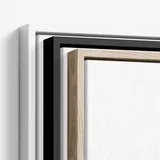
A canvas can also go in a floater frame: a wooden frame with a small gap around the canvas, which gives it a clean edge without glass. Canvas and framed paper can share a room, and even a wall. Use the canvas for the larger anchor piece and keep the paper prints together.
Match frames to the furniture
Frames are where art meets the rest of the room. A few rules keep it simple:
- Repeat a wood tone. An oak frame next to an oak coffee table or shelf ties the art into the room. A dark wood frame does the same for darker furniture.
- Black for contrast, white for calm. Black frames sharpen a print and suit graphic work and photography. White frames disappear on a white wall and let the art float.
- Do not match everything. Repeat one tone, not all of them, or nothing stands out.
- A mat adds space. A wide border around the print makes a small piece look more considered and fills more wall without a larger print.
Frames and mats also make the piece bigger than the print. Plan with the outside size of the frame, not the print size on the label.
Light, glare and sun
Look at the wall at different times of day before you choose. Two things to check:
Reflections. A framed print has a glazed front, usually glass or plexiglass, and it reflects whatever is opposite it. On a wall facing a window, a dark print can turn into a mirror on a bright afternoon. If your main wall faces a window, a canvas or a lighter image avoids the problem. A lamp shining straight at a framed print causes the same thing at night. Angle lights from above or the side.
Direct sun. Light damage builds up over time and cannot be undone, which is why museums keep their lights low. At home you do not need to go that far, but avoid hanging any print where strong sun hits it for hours each day.
Scale mistakes, and how to test before you buy
The most common mistake in a living room is art that is too small. A single 30x40 cm (about 12x16 in) print over a three-seater sofa looks like a postage stamp. The second is hanging it too high, close to the ceiling, where it loses its link to the furniture.
You can test both for free. Cut paper to the outside size of the frame you are considering, tape it to the wall with painter's tape and live with it for a day. Sit on the sofa, then stand in the doorway. If the paper looks small, the art will too. Try a bigger sheet before you order.
The same paper template helps when you hang the real piece. If you rent, or you would rather not drill, our guide on how to hang art without nails covers adhesive strips, ledges and what each wall type can hold.
Mixing originals and prints
You do not need all originals. An original has a surface a print cannot reproduce: brushstrokes, paper texture, pencil marks. A good print gives you the colour and detail of the work for much less.
Put a small original at eye level where people see it up close, and let a larger print carry the size. On a gallery wall, frame them the same way.
Buy from independent artists
Art from an independent artist makes a living room feel like yours rather than like a showroom, and you get a piece fewer people own. Many sell prints online, made to order in the size and finish you choose. Check the sizes on offer for the width your wall needs, pick canvas or framed paper to suit the light, and look for a photo of the piece in a room to judge the scale.
Sell your art with Printumo
Get started with selling your art as canvas and fine art prints
If you sell art: help buyers picture it in their living room
Everything above is what your buyers are thinking about: will your piece fit their wall, their colours and their sofa? A flat image of the artwork answers none of that.
Show each piece in a room, at its real size. Printumo's mockup generator lets you upload one artwork without an account and see it in photographed rooms, on canvas or paper, with frames and mats. Plain studio backgrounds are free, and every room style has some free rooms.
Mockups for Printumo products are made in the real frame, mat and size, so a buyer who sees a 50x70 cm (about 20x28 in) print above a sofa is seeing the true scale. Printumo then prints each order on demand, as canvas or fine art paper, framed or unframed, and ships it to the buyer. For other ways to make room pictures, from Photoshop to your own photos, read how to make art mockups.
Frequently asked questions
How do I choose art for my living room?
Start with the wall and the size: about two thirds of the width of the sofa or furniture below it. Then choose a colour approach (pull from the room, contrast with it, or stay neutral) and a mood that suits how you use the room. Choose the individual piece last.
How do I choose wall art for a living room with a big wall?
Fill about 60 to 75 percent of the open width with one large piece or a group. If furniture stands against the wall, size the art to the furniture instead.
Should living room art match the sofa?
It should connect to the room, not copy it. Repeat one colour or wood tone from the sofa, cushions, rug or furniture, and let the rest differ.
What size art should go in a living room?
Above a sofa, aim for two thirds to three quarters of the sofa's width: about 140 to 158 cm (55 to 62 in) for a 210 cm (83 in) sofa. Test it with a paper template before you buy.
Is canvas or framed art better for a living room?
Canvas has no glazing, so it suits walls opposite windows and large sizes. Framed paper prints look crisp and suit photography, drawings and gallery walls, but the glazed front can reflect light. Many living rooms use both.
How high should art hang in a living room?
Above a sofa, leave 15 to 25 cm (6 to 10 in) between the sofa back and the bottom of the frame. On a wall without furniture, put the centre of the art about 145 to 150 cm (57 to 60 in) from the floor.