

Custom canvas prints for artists: sizes, files, edges and frames

To turn your artwork into custom canvas prints you can sell, you make five decisions: the shape of the canvas, the sizes you offer, a file with enough pixels for the largest size, what happens at the edges, and whether to offer a frame. Get those right once and every print after that is made the same way.
This guide walks through each decision with real numbers, then covers the listing photos that sell a canvas online.
Step 1: choose the shape of your canvas
Every canvas size belongs to a shape, also called an aspect ratio. Your artwork already has one. A 30 x 40 cm painting is 3:4, a full-frame photo is 3:2, and a square sketchbook page is 1:1.
The shape matters more than the size, because a canvas of a different shape has to be cropped. If you put a 3:2 photo on a square canvas, about a third of the picture is cut away.
Printumo sells 49 canvas sizes in 7 shapes. Every size can be landscape or portrait, and every size comes unframed or in all four standard frame colours.
| Shape | Smallest size | Largest size | Typical source |
|---|---|---|---|
| 1:1 (square) | 20 x 20 cm (8 x 8 in) | 135 x 135 cm (53 x 53 in) | Square paintings, Instagram-format work |
| 5:4 (near-square) | 25 x 20 cm (10 x 8 in) | 150 x 120 cm (60 x 48 in) | Many painting panels, medium-format photos |
| 4:3 (classic) | 40 x 30 cm (16 x 12 in) | 165 x 120 cm (64 x 48 in) | Phone photos, many tablets and drawing apps |
| 7:5 (slightly wider) | 55 x 40 cm (21 x 15 in) | 180 x 125 cm (70 x 50 in) | Close to A-series and 50 x 70 cm work |
| 3:2 (photo) | 30 x 20 cm (12 x 8 in) | 150 x 100 cm (60 x 40 in) | Camera photos |
| 16:9 (wide) | 80 x 45 cm (32 x 18 in) | 165 x 90 cm (64 x 36 in) | Landscapes, screen-format art |
| 2:1 (panoramic) | 50 x 25 cm (20 x 10 in) | 150 x 75 cm (60 x 30 in) | Panoramas, long horizons |
Two rules make this simpler:
- One shape per product. A product offers the sizes of one shape, picked from the shape of your file. If you want a square and a 3:2 version of the same artwork, make two products from two crops.
- Crop once per shape. You set the crop once, and that crop is used for every size of that shape. You do not need a separate file per size.
Inches are exact, centimetres are rounded
Canvas is made to inch sizes. The centimetre label next to each size is rounded to the nearest 5 cm because round numbers read better in a shop. A canvas sold as 100 x 100 cm is really 40 x 40 inches, which is 101.6 cm.
If you design artwork to an exact size, design to the shape and use the inch figure. Do not build a file to the rounded centimetre label, or it will be cropped slightly to fit the real shape.
Step 2: decide which sizes to offer
You do not have to offer all sizes of a shape. A short, deliberate range is easier for buyers than a long list.
A practical ladder is three to five sizes: one small size people buy on impulse, one or two medium sizes for a bedroom or a hallway, and one large statement size for above a sofa or a bed. For help with what fits a wall, see what size art above a couch.
The limit on the largest size is usually your file, which is the next step.
Step 3: check your file has enough pixels
Canvas has a woven surface that hides very fine detail, so it needs less resolution than paper. Printumo recommends 150 DPI for canvas and 300 DPI for fine art paper.
Because canvas is made to inch sizes, the sum is simple: inches x 150.
| Canvas size | Pixels needed at 150 DPI |
|---|---|
| 30 x 30 cm (12 x 12 in) | 1800 x 1800 |
| 50 x 40 cm (20 x 16 in) | 3000 x 2400 |
| 60 x 40 cm (24 x 16 in) | 3600 x 2400 |
| 70 x 50 cm (28 x 20 in) | 4200 x 3000 |
| 90 x 60 cm (36 x 24 in) | 5400 x 3600 |
| 100 x 100 cm (40 x 40 in) | 6000 x 6000 |
| 120 x 80 cm (48 x 32 in) | 7200 x 4800 |
| 150 x 100 cm (60 x 40 in) | 9000 x 6000 |
A 24 megapixel camera gives about 6000 x 4000 pixels, which covers a 3:2 canvas of 90 x 60 cm (36 x 24 in) comfortably. A good phone photo of a painting usually covers the medium sizes.
When you upload, each size gets a quality dot based on your file's pixels. If the largest sizes show amber or red, either leave them out or enlarge the file. The full explanation is in DPI vs pixels, and the checklist for formats and colour is in preparing your art files for Printumo.
Two file points that catch people out:
- Export in sRGB. Other colour profiles are converted to sRGB, and Printumo does not adjust brightness, contrast or sharpness. Prints often look a little darker than a bright screen, so check shadows before you export.
- Use a supported format. JPEG, PNG, TIFF, HEIC and PDF (first page only) are accepted. WebP is not, so convert it first.
Step 4: choose what happens at the edges
A canvas is stretched over wooden stretcher bars, 3.2 cm (1.25 in) deep in Europe, the UK and Canada, and 3.8 cm (1.5 in) deep in the US. Something has to cover the sides. You pick one of three options when you set up the product.
| Edge option | What you see on the sides | What happens to the front |
|---|---|---|
| Mirrored edges (default) | A mirrored copy of the outer band of the image | The whole picture stays on the front |
| Stretched | The image itself continues round the sides | About 4 cm on each side moves off the front onto the sides |
| Solid colour | A colour you choose | The whole picture stays on the front |
Mirrored edges are the safe choice for most art, and especially for anything with detail near the border. Stretched looks lovely on landscapes and loose abstracts where the outer band holds nothing important. It is the wrong choice for a painting with a signature in the corner, a border or a subject close to the edge, because that part ends up on the side.
Solid colour gives a clean, graphic look. Pick a colour from the artwork, or a neutral such as white or black.
Step 5: frame or no frame
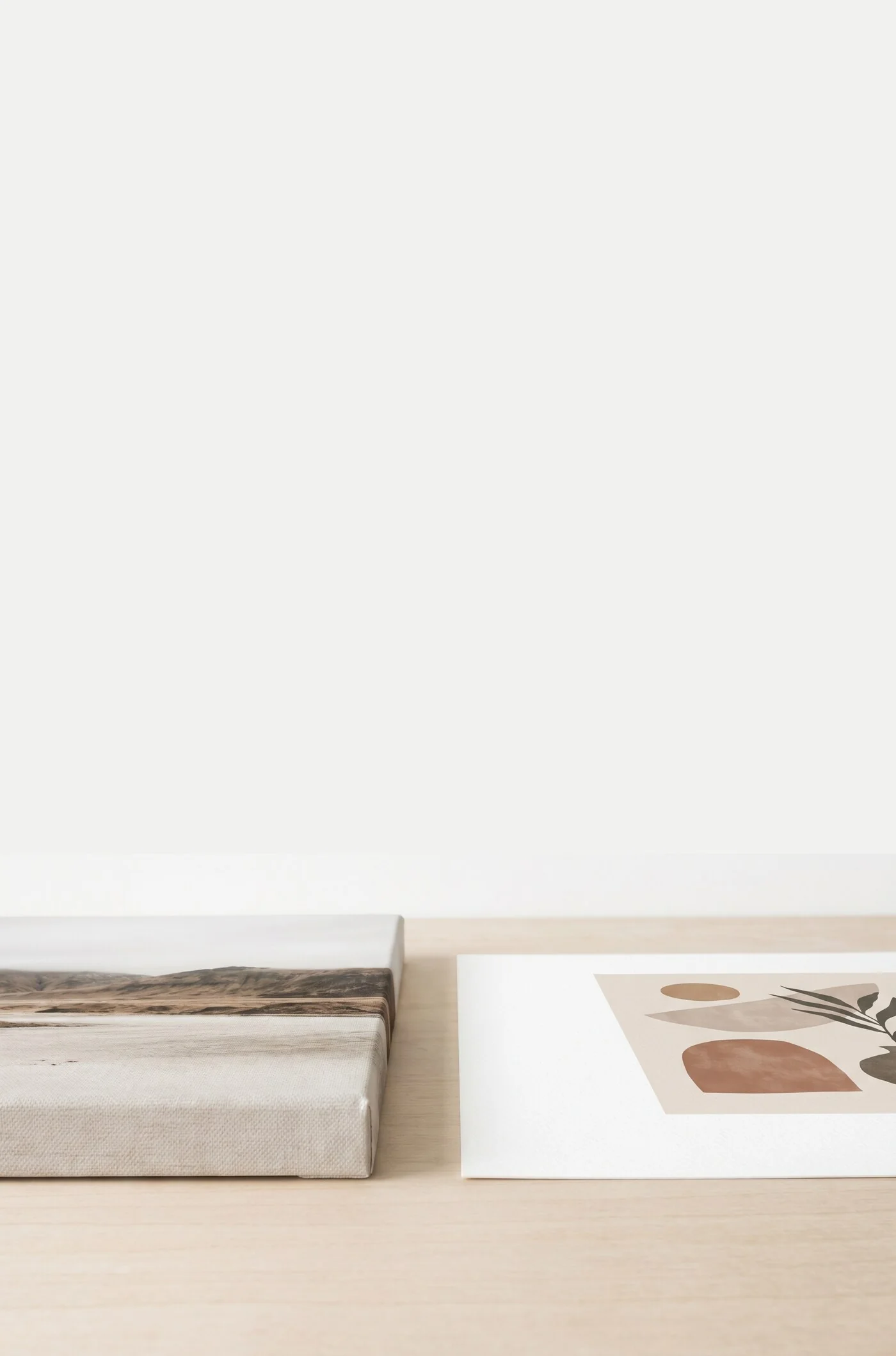
Every canvas can be sold unframed, ready to hang as it is, or in a floater frame. A floater frame leaves a small gap between the canvas and the frame, about 5 mm in Europe and the UK, so the canvas appears to float inside it.
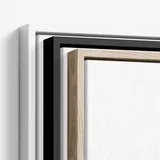
The standard floater frames are wooden frames in Oak, Dark Oak, White and Black. In Europe and the UK there is also a colored-frame line of ten sizes with Blue, Orange, Pink and Yellow frames as well as the four standard colours. It ships to 30 European countries, the UK included, so use the standard frames if you sell worldwide.
As a starting point, oak suits warm palettes and landscapes, dark oak suits bold or earthy work, white suits light and pastel work, and black suits photography and strong contrast. Framed canvas costs more to make, so it also supports a higher retail price. The framing page shows every option.
Canvas or fine art paper?
Canvas is not the best fit for every piece. A quick rule of thumb:
- Choose canvas for paintings, especially oil and acrylic, for large statement sizes, and for buyers who want something ready to hang without glass.
- Choose fine art paper for detailed drawings, watercolour, typography and crisp photography, where the smoother surface keeps the finest detail.
You do not have to pick one for your whole range. If you are unsure how the surface affects your work, see glossy canvas vs matte canvas and museum quality giclée printing explained.
Sell your art with Printumo
Get started with selling your art as canvas and fine art prints
Listing photos that sell a canvas
Scale is the hardest thing to judge online, and canvas makes it harder because buyers also need to see the depth and the edges. Plan for three kinds of picture per listing:
- A room picture that shows the canvas at its real size above a sofa, a bed or a desk.
- A straight-on picture of the artwork, so the detail is clear.
- An angled or close-up picture that shows the depth of the canvas and the edge you chose.
Then write a short description that answers the practical questions: the material, the sizes, the frame options, the edge, and that it arrives ready to hang. Clear facts build more trust than long adjectives. For more on this, read how to make art mockups.
Where Printumo fits
Printumo is a print-on-demand service for wall art. You upload your artwork once, choose your sizes, edges and frames, and each canvas is made when a buyer orders it and shipped straight to them in neutral, unbranded packaging. An account is free. You pay the print price and shipping only when a print is ordered.
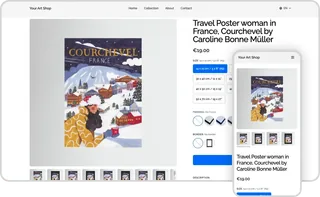
Every product you create gets mockups made automatically, in the real frame and size, and the ones you pick become the listing photos in your connected store on Shopify, Etsy, WooCommerce, Wix or Squarespace, or in a free Printumo Shop. You can try it first with one artwork in the mockup generator, without an account and without a watermark.
Before you sell, order one canvas for yourself to check colour, edges and size in your own hands. There is 30% off the prints and frames in your first order when you place it within 48 hours of signing up.
Frequently asked questions
What resolution do I need for a canvas print?
About 150 DPI at the printed size. Multiply each side in inches by 150. A 36 x 24 inch canvas needs about 5400 x 3600 pixels. Fine art paper needs about twice as many pixels per side, at 300 DPI.
Why is my artwork cropped on some canvas sizes?
Because the canvas is a different shape from your file. Each product uses one shape, and a size of another shape would cut part of the picture away. Make a separate crop and product for each shape you want to sell.
Which edge should I choose for a canvas print?
Mirrored edges for most artwork, because the whole picture stays on the front. Choose stretched only when the outer 4 cm or so on each side holds nothing important, and solid colour for a clean, graphic edge.
Can I offer framed canvas prints?
Yes. Every canvas size can be sold in an Oak, Dark Oak, White or Black floater frame, or unframed. In Europe and the UK, a ten-size colored-frame line adds Blue, Orange, Pink and Yellow.