


Canvas print dropshipping vs print on demand: which one fits an artist?

Dropshipping means you sell a supplier's ready-made products and the supplier ships them to your buyer. Print on demand means each canvas is printed from your own file only after someone orders it, then shipped to your buyer. If you are an artist selling canvas prints of your own work, print on demand is the model that fits, even when people call it dropshipping.
The two terms get mixed up because they share one thing: you never pack a parcel. The difference is what gets made, and from whose design. That decides who owns the artwork, how much of the price you control and what can go wrong.
What canvas print dropshipping means
In classic dropshipping, a supplier has a catalog of finished products. Those are often canvas prints of stock images or designs the supplier owns or licenses. You list some of them in your store at your own price. When a buyer orders, you pass the order to the supplier, who ships it from their stock or prints it from their own file.
You never design anything. You pick products, write listings and market them. Your income is the gap between the supplier's price and yours.
That model can work for a home decor shop. For an artist it misses the point, because the products are not your art. You also compete with every other store that lists the same supplier products, often at a lower price.
What print on demand means
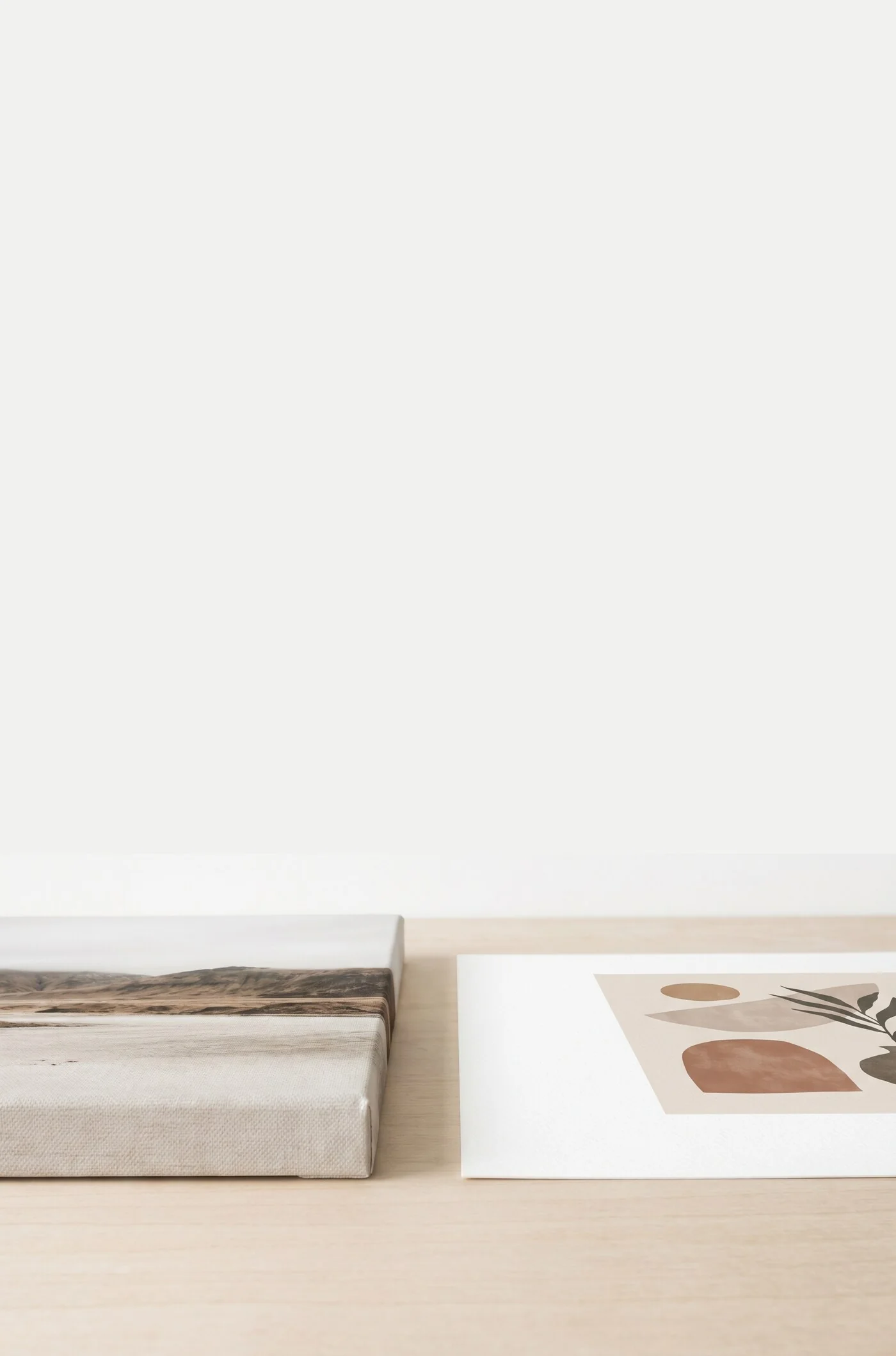
With print on demand you upload your own artwork once and choose the products: canvas sizes, frames, edges. Nothing is printed in advance. When a buyer orders, the provider prints that exact canvas from your file, stretches it and ships it to the buyer.
The artwork is yours, so nobody else sells the same piece. You set the retail price. The provider charges you a print price and shipping for each order, and the rest is your margin.
When artists say "dropshipping canvas prints", this is almost always what they mean: their own art, printed per order and shipped straight to the buyer.
Dropshipping vs print on demand side by side
| Classic dropshipping | Print on demand | |
|---|---|---|
| Who owns the design | The supplier or its licensor | You |
| Stock | The supplier holds finished goods, or prints from its own files | None. Each print is made after it is ordered |
| What is printed and when | Supplier products, often made in advance | Your file, printed after the order |
| Exclusive to you | No, other stores can list the same products | Yes, the artwork is yours |
| Branding and packaging | Depends on the supplier | Depends on the provider, look for neutral packaging |
| Lead time | Shipping time, sometimes from far away | Production time plus shipping |
| Margin control | You set your price, but buyers can compare identical products | You set your price for work nobody else sells |
| Quality control | You trust the supplier's product | You control the file, the provider controls the print |
| Up-front risk | Low, no stock | Low, no stock |
| Main risk | Price competition on identical products | Low sales if nobody finds your work |
Both models keep you away from stock and packing. The real difference is ownership. Print on demand lets you sell your own art, so you are competing on the artwork itself and not on the price of a product anyone can copy.
Where each model fits
Dropshipping fits if you want to run a decor store without making art. You curate, market and sell products that already exist.
Print on demand fits if you make art and want to sell prints of it. You hold no stock, you can offer many sizes without paying for any of them up front, and you can add a new artwork the day you finish it.
Why print on demand quality depends on two things
Print on demand is not consistent by magic. Two things decide whether every canvas that leaves the printer looks like the one you approved.
Your file. The print can only be as good as the pixels you send. Canvas needs about 150 DPI at the printed size. A 50 x 70 cm (20 x 28 in) canvas needs about 3000 x 4200 pixels, and a 100 x 150 cm (40 x 60 in) canvas about 6000 x 9000. Export in sRGB, check the crop for each shape you sell, and decide the edge style before you publish. The full checklist is in preparing your art files for Printumo.
The provider's process. A fixed print method, fixed materials and a fixed set of products are what make the hundredth print match the first. Ask what the canvas is, how it is stretched and what the stretcher bars are. A provider that publishes those details is one you can hold to them.
What a canvas print costs you per sale
The cost structure is similar in both models, but the lines are worth spelling out.
With print on demand, each sale costs you:
- the print price for that size and frame
- shipping, unless you charge the buyer for it
- the fees of the place you sell (marketplace fees, payment fees or a store plan)
Your profit is what is left from your retail price. A worked example with real print costs is in how to price art prints.
With dropshipping, the lines are the same, except the product price is the supplier's wholesale price for their item. The difference is that identical items are easy to compare, so the retail price tends to get pushed down.
What to check before you choose a provider
Whatever you call it, these are the questions that decide whether a canvas provider works for you:
- Packaging. Does the parcel arrive in neutral packaging, with no provider branding? Your buyer bought from you.
- Tracking. Is the tracking number sent back to your store order automatically, so your buyer gets it without you copying anything?
- Integrations. Does it connect to the store you use, and can it import listings you already have?
- File requirements. What file formats, resolution and color profile does it want? Does it tell you, per size, whether your file is big enough?
- Canvas details. Canvas material, stretcher bar depth, edge options and frame options.
- Damage. Who replaces a canvas that arrives damaged, and how do you report it?
- Cancellation window. Is there time to cancel an order the buyer changes their mind about before it is printed?
- Where it is made. A canvas printed near the buyer travels less.
Edges and sizes are your choices
With print on demand you make product decisions a dropshipping supplier makes for you. The edge matters most on canvas. Mirrored edges keep the whole picture on the front and reflect the outer band onto the sides. Stretched edges wrap the picture itself around the bars, so about 4 cm on each side moves off the front. If your work has detail or a signature near the edge, choose mirrored. For sizes, start with three or four across a price range, not every size there is.
Sell your art with Printumo
Get started with selling your art as canvas and fine art prints
Common mistakes when choosing between the two
Choosing on print price alone. The cheapest canvas is not the cheapest product if it leads to returns and bad reviews. Order one for yourself first and look at the corners, the edges and the colors.
Selling designs you do not own. Dropshipping supplier designs is fine. Uploading someone else's image to a print-on-demand service is not. Print on demand is for work you own or have licensed.
Skipping your own test print. A file that looks fine on screen can print darker, softer or cropped differently. Order the print to your own address before you sell it.
Where Printumo fits
Printumo is a print-on-demand service for wall art. You upload your artwork, create canvas and fine art paper products, framed or unframed, and each order is printed and shipped to your buyer when it comes in. There is no stock and no minimum.
What that looks like in practice:
- Canvas is a 340 gsm poly cotton blend with a matte to satin finish, giclée printed and hand-stretched. The stretcher bars are 3.2 cm (1.25 in) deep in Europe, the UK and Canada, and 3.8 cm (1.5 in) in the US. Each canvas arrives ready to hang with a sawtooth hanger and rubber bumpers.
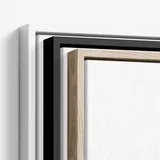
- Edges are mirrored, stretched or solid color, and floater frames come in Oak, Dark Oak, White and Black.
- Packaging is neutral and unbranded, so the parcel comes from you as far as your buyer can tell.
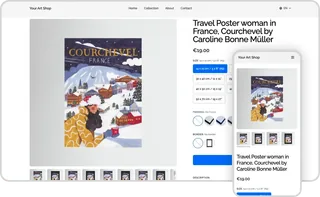
- Stores. Printumo connects to Shopify, Etsy, WooCommerce, Wix and Squarespace, and sends tracking back to the store order. If you have no store, Printumo Shop is a free hosted webshop with no monthly fee and 0% commission.
- Files. Each size shows a quality dot based on your file's pixels, so you can see which sizes will print sharp before you publish.
- Time to cancel. By default an order waits 30 minutes before it is charged and produced, so a buyer can still change their mind.
An account is free and no subscription is needed. You can order a print for yourself to check it before you sell, and there is 30% off the prints and frames in your first order when you place it within 48 hours of signing up. Create a free account to start.
Frequently asked questions
Is print on demand the same as dropshipping?
Not quite. Both ship to the buyer without you holding stock. Dropshipping usually means reselling a supplier's ready-made products. Print on demand means each item is printed from your own design after it is ordered. For artists selling their own canvas prints, print on demand is the accurate term.
Can I dropship canvas prints of my own art?
Yes, and that is print on demand. You upload your artwork, connect your store, and the provider prints and ships each canvas after it is ordered.
Do I need to buy stock to sell canvas prints online?
No. With print on demand nothing is printed until a buyer orders, so you pay the print price and shipping only for prints that have been sold.
Which is more profitable, dropshipping or print on demand?
It depends on your prices and costs, not on the model. Print on demand gives you work nobody else can sell, which makes it easier to hold your price. Work out your margin per size with the method in how to price art prints.
How do I know my canvas will look right before a buyer gets it?
Order one to your own address first. Check the colors, the crop, the edges and the corners, and fix the file if anything is off.