



The best website to sell art prints: an honest comparison

There is no single best website to sell art prints. The right one depends on a trade: a marketplace gives you its audience, and your own shop gives you the margin and the control. Many artists end up using one of each.
This guide compares six types of site, says plainly what each does well and badly, and ends with a decision guide.
Fees and plans change often, so no third-party fees are quoted here. Check the current fee page of any platform before you commit.
The options at a glance
| Option | Who brings the buyers | Who sets the price | Your branding and customer contact | Monthly cost |
|---|---|---|---|---|
| Free hosted shop with printing built in (Printumo Shop) | You | You | Yours | No |
| Etsy | Etsy search, plus you | You | Limited, inside Etsy | No monthly fee for a standard shop, fees per listing and sale |
| Own store (Shopify, Wix, Squarespace, WooCommerce) with print on demand | You | You | Fully yours | Yes, a plan or hosting |
| Print-on-demand marketplace (Redbubble, Society6, Fine Art America) | The marketplace | The marketplace sets the base, you add a margin or earn a royalty | Mostly the marketplace's | Depends on the site and plan |
| Curated or original-art marketplace (Saatchi Art) | The marketplace | You, the site takes a commission | Limited | Check the site |
| Instagram and other social channels | You | You, in the shop you link to | Yours | No |
1. Your own free hosted shop with printing built in
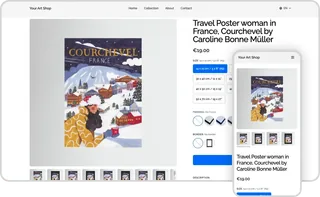
This is a ready-made webshop where printing and shipping are part of the service.
Printumo Shop is one example. It is a free hosted webshop at printumo.com/shop/your-name, with prints, prices, shipping rates and legal pages already in place and no limit on the number of artworks. There is no monthly fee and 0% commission. Printumo bills only the printing and shipping of each print.
Buyers pay by card at a built-in checkout. You connect your bank and the money is paid out to you. The payment provider's own card fees apply.
You can also list original artworks beside your prints, at your own price, and ship those yourself. An own domain, discount codes and detailed statistics need Printumo+, the paid plan.
The trade-off. You keep the margin and the customer relationship, but a new shop has no visitors. Nobody finds it unless you send them there.
2. Etsy
Etsy is a marketplace with its own search and a large base of buyers who arrive ready to buy handmade and art items. That is its main strength: a listing can be found by people who have never heard of you.
The costs are spread across several fee types, typically per listing, per sale and for payment processing. Competition is heavy, and your listing sits next to similar work at every price. Your shop looks like an Etsy shop, and the buyer is in practice Etsy's customer, with limits on how you can contact them afterwards.
You do not need to print and pack yourself. A print-on-demand service can be connected so orders are fulfilled automatically. The full setup is in how to sell art on Etsy.
The trade-off. Built-in buyers, in exchange for fees, competition and less control.
3. Your own store connected to print on demand
Here you build a store on Shopify, Wix, Squarespace or WooCommerce and connect a print-on-demand service that prints and ships each order.
You control everything: the design, the domain, the prices, the email list. These platforms also offer more features than a simple hosted shop, such as apps, advanced discounts and detailed reporting.
It costs money before you sell anything. Shopify, Wix and Squarespace charge for a plan that can take payments. WooCommerce is a free plugin, but you pay for hosting and look after the site yourself.
The trade-off. The most control and room to grow, with a fixed cost and no traffic of its own.
Sell your art with Printumo
Get started with selling your art as canvas and fine art prints
4. Print-on-demand marketplaces
Redbubble, Society6 and Fine Art America combine a marketplace with production. You upload a design, the site puts it on prints and other products, and it handles printing, shipping and customer service.
The marketplace sets the base price of each product. You earn a margin you add on top or a royalty per sale, depending on the site. That usually means a smaller amount per print than selling the same print in your own shop, and less say over the final price.
These sites are the least work, and their visitors can find your art through the site's search. But the catalogs are huge, the buyer belongs to the marketplace, and you usually do not learn who bought your work. For a closer look at one of them, see Printumo compared with Redbubble.
The trade-off. Almost no effort and some built-in audience, in exchange for low earnings per sale and little control.
5. Curated and original-art marketplaces
Sites such as Saatchi Art focus on original paintings, drawings and photography, often with prints as a second line. Buyers there expect higher prices and are looking for art in particular, which suits original work that would look out of place among posters.
The site takes a commission on each sale, and you normally pack original pieces yourself to the site's standards.
The trade-off. A better-matched audience for originals, in exchange for commission and less freedom over how you present and ship.
6. Instagram and other social channels
Social platforms are where many artists are discovered, but they are a poor place to complete a sale. Selling through direct messages means handling payment, addresses and shipping by hand for every order.
The practical setup is a profile that shows the work and a link to a shop where people can pay. Seen that way, social is a traffic source for option 1, 2 or 3, and it is the cheapest one you have.
The trade-off. No cost and a direct line to followers, but it needs a real shop behind it.
Where can I sell my art online for free?
Several options cost nothing to start. A free hosted shop such as Printumo Shop has no monthly fee and no commission. Print-on-demand marketplaces are often free to join, and a social profile is free.
Nothing is free per sale, though. Someone always pays for printing, shipping and card processing, and marketplaces take their share from each order.
Best websites to sell art on for beginners
If you are starting out, the first sales matter more than the perfect setup. Pick options with no fixed monthly cost, so slow months cost you nothing.
A sensible first step is one marketplace for discovery and one free shop of your own to send followers to.
Alternatives to Etsy for artists
Artists usually look for alternatives to Etsy for one of three reasons, and each points somewhere else:
- The fees take too much of each sale. Move your returning buyers and followers to your own shop (options 1 and 3) and keep Etsy for strangers.
- You want your own brand and your buyers' details. An own shop gives you both.
- You want less work. A print-on-demand marketplace (option 4) takes over nearly everything, at a lower income per sale.
You do not have to leave Etsy to do any of this. Running an Etsy shop and an own shop side by side is common.
Which one should you choose?
- If you have no audience yet and want strangers to find you, choose a marketplace such as Etsy.
- If you have followers or an email list, choose your own shop, because you already have the traffic and keep more of each sale.
- If you want no monthly cost, choose a free hosted shop, alone or next to a marketplace.
- If you sell mainly originals at higher prices, add a curated marketplace.
- If you want full control and plan to grow a brand, choose your own store on Shopify, Wix, Squarespace or WooCommerce.
- If you only want to upload and do nothing else, choose a print-on-demand marketplace and accept the lower earnings.
How to bring traffic to your own shop
An own shop only works if you send people to it. These are the usual sources, roughly in order of effort:
- Your social profiles. Put the shop link in your bio and post finished work with the print shown in a room.
- An email list. Collect addresses from day one. People who asked to hear from you are the most likely to buy a new collection.
- Search. Give each artwork a descriptive title and text that says what it shows, the style and the colors. Results build slowly over months.
- Pinterest. Pins link straight to a product and keep being found long after you post them.
Where Printumo fits
Printumo Shop is the free own-shop option described in section 1: no monthly fee, 0% commission, and you pay for printing and shipping only when a print is ordered. The payment provider's card fees apply.
The choice is not either/or. Printumo also connects to Shopify, Etsy, WooCommerce, Wix and Squarespace, so the same prints can sell in a marketplace and in your own shop, with orders printed and shipped the same way.
A practical start: open a Printumo Shop for your followers, connect Etsy for discovery, and compare what you keep per sale after a few months.
Frequently asked questions
What is the best website to sell art prints?
There is no single best one. A marketplace is best when you need buyers you do not have yet, and your own shop is best when you can bring visitors and want to keep the margin and the customer. Many artists use both.
What are the alternatives to Etsy for artists?
Your own hosted shop, your own store on Shopify, Wix, Squarespace or WooCommerce, print-on-demand marketplaces such as Redbubble, Society6 and Fine Art America, and curated marketplaces such as Saatchi Art. Each gives a different mix of audience, control and earnings per sale.
Where can I sell my art online for free?
You can open a free hosted shop, join many print-on-demand marketplaces or sell through a social profile without paying up front. Printing, shipping and payment fees still apply to each sale, so compare what you keep per order.