


Art print vs poster vs canvas: what is the difference?

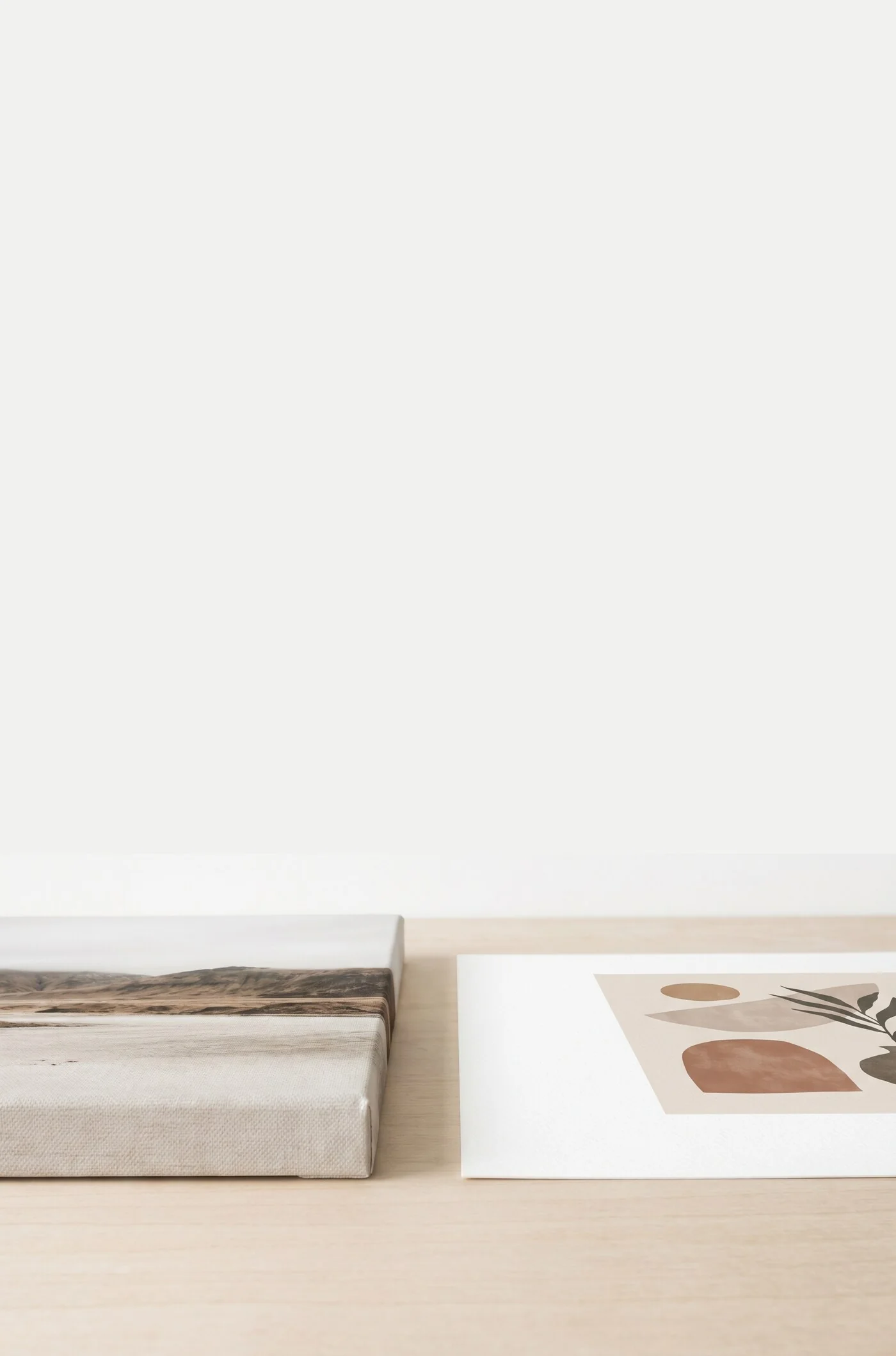
A poster is usually printed in large runs on thin, often glossy paper, and it is made to be cheap. An art print, also called a fine art print or giclée print, is made one at a time or in small runs on an inkjet printer, on heavier matte art paper chosen for colour and longevity. A canvas print is printed on canvas and stretched over a wooden frame, so it hangs without glass. The names overlap in shops, so look at the paper, its weight and the printing method rather than the label.
Art print vs poster vs canvas at a glance
| Poster | Art print (fine art paper) | Canvas print | |
|---|---|---|---|
| Material | Thin paper, often glossy or satin coated | Heavier matte art paper | Canvas fabric stretched over wooden bars |
| Printing | Often offset printing in large runs, or fast digital printing | Inkjet (giclée), one at a time or in small runs | Inkjet (giclée), one at a time |
| Feel | Light, flexible, creases easily | Thick and stiff, with a soft matte surface | A rigid panel a few centimetres deep |
| Look | Can be bright and shiny, reflects light | Fine detail, no shine | Visible weave, matte or satin finish |
| Longevity | Not usually made to last | Made to last when the paper and inks are archival | Made to last, with a sturdy surface |
| Hanging | Needs a frame, or tape and pins | Best in a frame, often with a mat | Ready to hang, no frame needed |
| Price | Lowest | Middle unframed, higher framed | Higher than unframed paper |
| Best for | Short-term decor, events, student rooms | Detailed work, gallery walls, framed pieces | Large statement pieces, bright rooms |
These are typical differences, not rules. A cheap art print can be worse than a good poster, and a good poster shop may print on thick paper. That is why the checks further down matter more than the name.
What is a poster?
A poster was originally an advertisement or announcement: printed in large numbers, pasted on a wall and replaced next month. Many wall posters sold today follow the same idea. They are printed in bulk, often by offset printing, on thin coated paper, and sold rolled or flat for a low price.
That does not make posters bad. A poster is a good way to put a film, a band or a museum show on the wall for little money. It is just not designed to look like a piece of art up close, or to keep its colours for decades.
What is an art print?
An art print is a reproduction of an artwork made for display. The term most often means a fine art print or giclée print: an inkjet print on heavy, matte art paper, made in small numbers or one at a time when it is ordered.
The paper is the main difference you can feel. Fine art paper is thicker, has no glossy coating, and holds fine detail and soft colour transitions well. Good fine art papers are acid-free, which helps them stay white rather than yellowing. We explain the printing side in museum-quality giclée printing explained.
An art print is not the same as an original. It is a copy, often of a painting or drawing, sometimes of a digital work that only ever existed as a file.
What is a canvas print?
A canvas print is printed on canvas fabric instead of paper. The canvas is then stretched over a wooden frame (the stretcher bars) and fixed at the back, so the finished piece is a rigid panel that hangs straight on the wall.
Canvas prints have no glass, so there is nothing to reflect windows and lamps. The weave of the canvas shows faintly through the image, which suits paintings and soft photographs and is less suited to tiny lettering or very fine line work. Canvas finishes range from matte to glossy. Our article on glossy canvas vs matte canvas covers the finishes.
Art print vs poster: how to tell them apart
Shops use "print", "art print" and "poster" loosely. Some sell fine art paper prints under the name "poster", and some sell posters as "art prints". Before you buy, check these:
- Paper weight. It is given in gsm (grams per square metre). A higher number means a thicker sheet. If a shop does not state the weight at all, ask.
- Paper type. Look for words like "fine art paper", "archival" or "acid-free". "Satin poster paper" describes a different, cheaper product.
- Printing method. "Giclée" or "inkjet" suggests an art print made on demand. A product description that says nothing about printing often means a mass-printed poster.
- Surface. Most fine art paper is matte. A thin, shiny sheet is usually a poster.
- Price. A large print for very little money is almost always a poster. Fine art paper and inks cost more.
- Who made it. A print sold by the artist or a gallery, with the artist's name and the size stated, is usually made with more care than one from a generic wall decor shop.
Art print vs canvas: which to choose for which room
Both are made to last. The choice is about look, size and where the piece will hang.
| Situation | Better choice | Why |
|---|---|---|
| Large statement piece above a sofa or bed | Canvas | Light for its size, no glass, ready to hang |
| Room with a window opposite the wall | Canvas, or framed paper hung away from the light | Glass and plexiglass reflect windows and lamps |
| Fine detail, line drawings, small text | Fine art paper | Smooth matte surface shows the finest detail |
| Gallery wall of several pieces | Framed paper | Matching frames and mats tie different works together |
| Small pieces on a shelf or narrow wall | Framed paper | A frame and mat give a small print more presence |
| Children's rooms and busy hallways | Canvas | No glazing at the front, and light for its size |
Keep any print, poster or canvas out of direct sunlight. Strong sun fades every kind of print over time, however good the inks are.
Framing an art print
An art print usually wants a frame. A mat (the card border inside the frame) gives the print space around it and keeps it off the glass. If you buy unframed, measure the print first and buy a frame made for that size. A frame bought for "A3" will not fit a 30x40 cm print.
Does a canvas need a frame?
No. A stretched canvas is finished on all sides and can hang as it is. A floater frame, which leaves a small gap around the canvas, gives it a more finished look, but it is optional.
Sell your art with Printumo
Get started with selling your art as canvas and fine art prints
For artists: which should you sell?
Paper and canvas reach different buyers. An unframed paper print is the lower-priced way into your work. Framed paper and canvas cost more, and buyers accept that because they arrive ready to hang.
Printing posters in bulk yourself means paying upfront and storing stock. Print on demand avoids both: each print is made when it is ordered and shipped to the buyer. Printumo makes canvas and fine art paper prints this way, framed or unframed, at a price you set for each. Printumo does not make posters.
Printumo's fine art paper prints are giclée prints on a matte fine art paper. In Europe the paper is 230 gsm. There are 17 sizes, from A5 to 100x140 cm (39.4x55.1 in), including inch sizes from 8x12 to 24x36 in. Framed prints come in wooden frames with a plexiglass front, in 14 colours, and every size can also have a mat in one of 11 colours. See the fine art paper print page for the details.
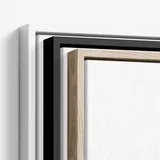
Printumo's canvas prints are hand-stretched and giclée printed on a 340 gsm poly cotton blend with a matte/satin finish. The stretcher bars are 3.2 cm (1.25 in) deep in Europe, the UK and Canada, and 3.8 cm (1.5 in) in the US. Each canvas comes ready to hang, with a hanger and rubber bumpers fitted. You can choose mirrored, stretched or solid colour edges and a floater frame in Oak, Dark Oak, White or Black. Sizes run from 20x20 cm (8x8 in) to 180x125 cm (70x50 in). The canvas page has the full list.
The fastest way to see the difference is to hold both. With order for yourself you can order a print of each for your own wall before you list them. If you place your first order within 48 hours of signing up, you get 30% off the prints and frames in it. For pricing the two, read how to price art prints.
Frequently asked questions
Is an art print the same as a poster?
Not usually. A poster is typically mass-printed on thin, often glossy paper. An art print is usually an inkjet (giclée) print on heavier matte art paper, made in small numbers. Some shops use the words interchangeably, so check the paper and printing method.
What is the difference between a fine art print and a poster?
The paper and the printing. A fine art print uses thick, matte, often acid-free paper and is printed with an inkjet printer, one at a time or in small runs. A poster uses thinner paper and is usually printed in bulk, so it costs less and is not made to last as long.
Is canvas better than a print?
Neither is better in general. Canvas suits large pieces and walls facing a window, because it has no glass to reflect the light and needs no frame. A fine art paper print shows finer detail and works well framed, especially in small sizes and gallery walls.
Do art prints need to be framed?
Not strictly, but a frame protects the paper and makes it look finished. A frame with a mat also keeps the print away from the glass. A canvas print is the exception: it is ready to hang without a frame.
Why are art prints more expensive than posters?
Fine art paper costs more than poster paper, and each print is made individually rather than in a run of thousands. Many art prints are also sold by the artist, so part of the price goes to the person who made the work.